
Summary preview
"Fathers and Sons": Why This Novel Still Blows Minds!
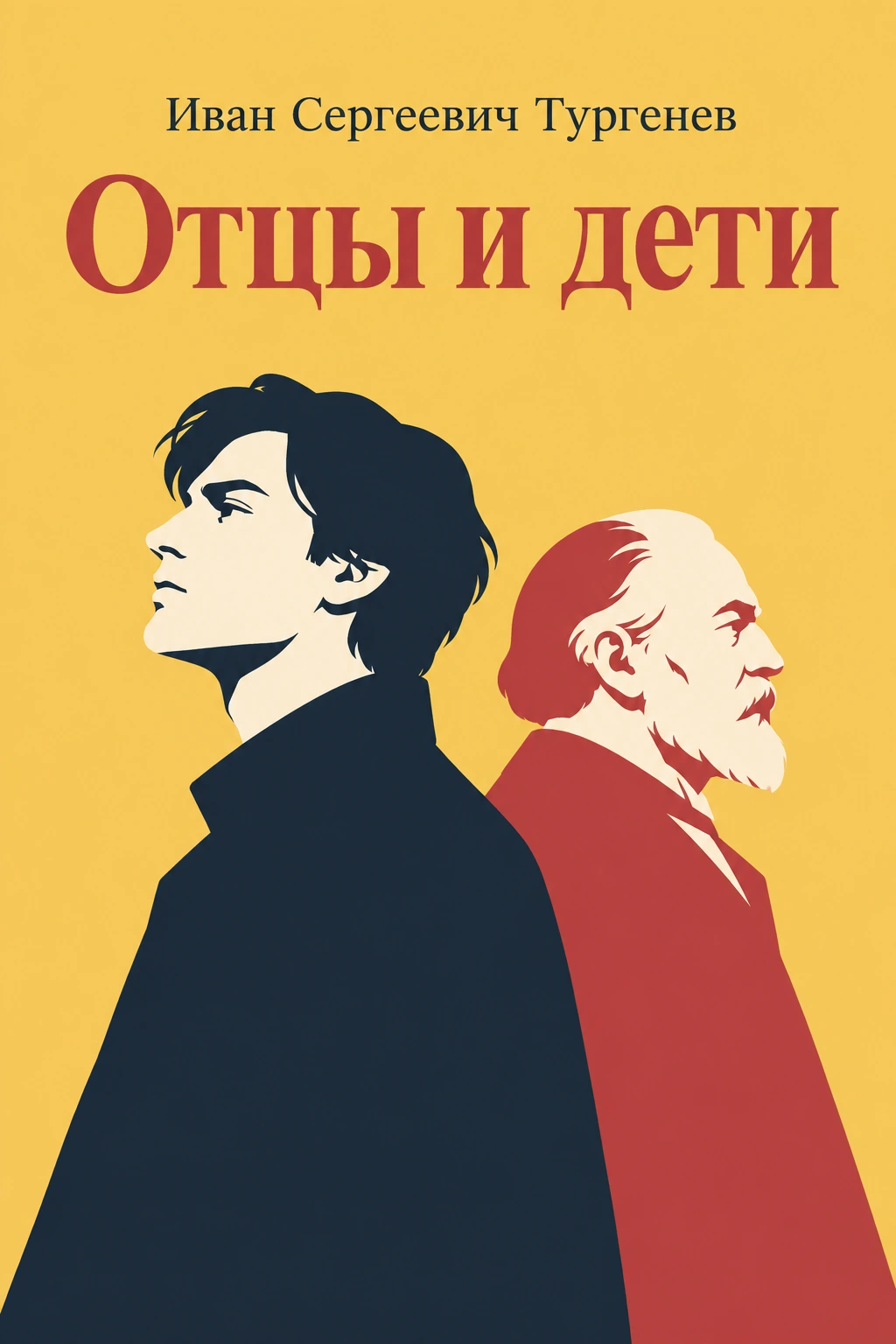
Hey everyone! Today, I want to chat about a book that, despite being written over a century and a half ago, still sparks heated debates and strong emotions. Yep, it’s Ivan Turgenev’s "Fathers and Sons." You know that feeling when you read something for school and think, "Ugh, so boring, why do I have to do this?" Then, years later, you pick it up again, and it hits you completely differently? That’s exactly what "Fathers and Sons" is like. It’s not just a novel; it’s a delayed-action bomb that’s more relevant today than ever.
Introduction: Way More Than Just Schoolwork
Let’s get one thing straight: if you read "Fathers and Sons" in school and came away thinking it was just a dull story about old people and young people, you totally missed the point. Turgenev, back in 1862, created something so groundbreaking that it still resonates with us today. The main character, Evgeny Bazarov, is a total game-changer. He’s a nihilist – someone who bows to no authority, questions all traditions, and challenges everything considered sacred. Naturally, he became a hero to many young people back then. His views, his uncompromising stance, his faith in science and reason – it was all incredibly inspiring. But Russia, as you know, is a special kind of country. As Dmitry Bykov aptly put it, Russia seems to undergo an ideological matrix shift every 15 to 20 years. This means each new generation tends to find itself in opposition to the previous one, both ideologically and morally. This eternal conflict, this drama of "fathers" versus "sons," never really goes away. So, when you pick up "Fathers and Sons" today, you're not just reading a historical document; you're looking into a mirror reflecting your own experiences and the societal shifts happening right now.
Main Theses: What Was Turgenev Getting At?
If we break it all down, the novel's main ideas can be summed up like this: The Eternal Conflict of Generations Drives Progress (and Drama): Turgenev showed that the clash between old customs and new ideas isn't just everyday life; it's the bedrock of societal development. Younger generations will always question the old and seek the new, while older generations cling to the familiar. There's nothing inherently good or bad about this; it's just a law of life. The novel explores this dynamic through its characters and their relationships. Bazarov's Nihilism Is More Than Just Rebellion; It's an Attempt to Build on Rational Foundations: Bazarov doesn't just reject things for the sake of it. He genuinely believes that science, reason, and materialism hold the key to understanding the world. He dismisses art, philosophy, religion – anything that can't be empirically proven. It's a challenge to everything that came before, an attempt to start fresh. Of course, such an approach was bound to alienate the conservative society of the time. Russia is a Land of Paradoxes Where Ideas Shift at Breakneck Speed: As Bykov noted, Russia's 'ideological matrix' seems to change every 15-20 years. What was cutting-edge yesterday might feel outdated today. Each new generation strives to distance itself from the previous one, to make its own mark. "Fathers and Sons" is a vivid illustration of this process, showing how quickly values and beliefs can transform. The Rebel Hero Is Often Lonely and Tragic: Bazarov isn't just an ideological figurehead; he's also a person with flaws and inner struggles. His uncompromising nature, his rejection of emotions and attachments, ultimately lead him to loneliness and a tragic end. Turgenev shows that behind outward bravado and self-confidence often lies deep internal conflict and a search for meaning.
Evgeny Bazarov: Man of the Future or Evolutionary Dead End?
Bazarov is, without a doubt, the heart of the novel. He’s young, energetic, intelligent, scorns convention, and is ready to overturn the world. He’s a doctor, a natural scientist, believing only in what he can touch, measure, and prove. His famous response when asked about his views – "I bow to no authority and take no principle on faith!" – is the epitome of his nihilism. He rejects art ("Can one learn to… love?"), philosophy, religion, marriage, even the simplest human feelings. Yet, Bazarov isn't just a destroyer. He wants to build a new, better society based on science and reason. He believes humans are products of nature, and all their actions can be explained physiologically. His attitude towards people often seems cynical and dismissive, but perhaps this hides a fear of his own emotions, of anything that might shake his convictions. Turgenev doesn't idealize Bazarov. He shows his weaknesses: his pride, his inability to grasp subtle human relationships, his loneliness. And when Bazarov falls for Anna Odintsova, he himself begins to question his principles. This storyline demonstrates that even the most convinced nihilist can't completely escape human nature.
Pavel Petrovich Kirsanov: The Old World vs. The New
Pavel Petrovich is Bazarov's polar opposite. He’s an aristocrat, a gentleman, a connoisseur of art, music, and the good life. He believes in traditions, in authority, in "principle." To him, Bazarov is a plebeian, an ignoramus, a dangerous destroyer. Their verbal duels are a clash of two worlds, two worldviews. Pavel Petrovich embodies the old, fading era, with its refinement but also its rigidity and resistance to change. He tries to argue with Bazarov on Bazarov's own terms – reason and logic. But Bazarov, with his more pragmatic and cynical outlook, easily defeats him. Pavel Petrovich cannot accept the idea that everything can be explained by science, that nothing is lofty or sacred. His love for the deceased princess, his idealized memories – these are what Bazarov dismisses as "romanticism" and "nonsense."
Nikolai Petrovich Kirsanov: A Lost Generation?
Nikolai Petrovich, Arkady's father, is perhaps the most tragic character. He tries to keep up with the times, takes an interest in new ideas, even attempts to manage his estate in new ways. But he struggles. He's kind, gentle, but indecisive. He loves poetry, nature, but can't find his place in the new world. He represents a generation caught between the old and the new, unable to fully embrace either. His relationship with Fenichka, a simple girl, shows his humanity but also his inability to overcome social barriers. He loves Arkady but doesn't understand his fascination with nihilism. He tries to connect with Bazarov, but Bazarov treats him with mild condescension. Nikolai Petrovich symbolizes a generation that has lost its bearings and doesn't know where to go next.