
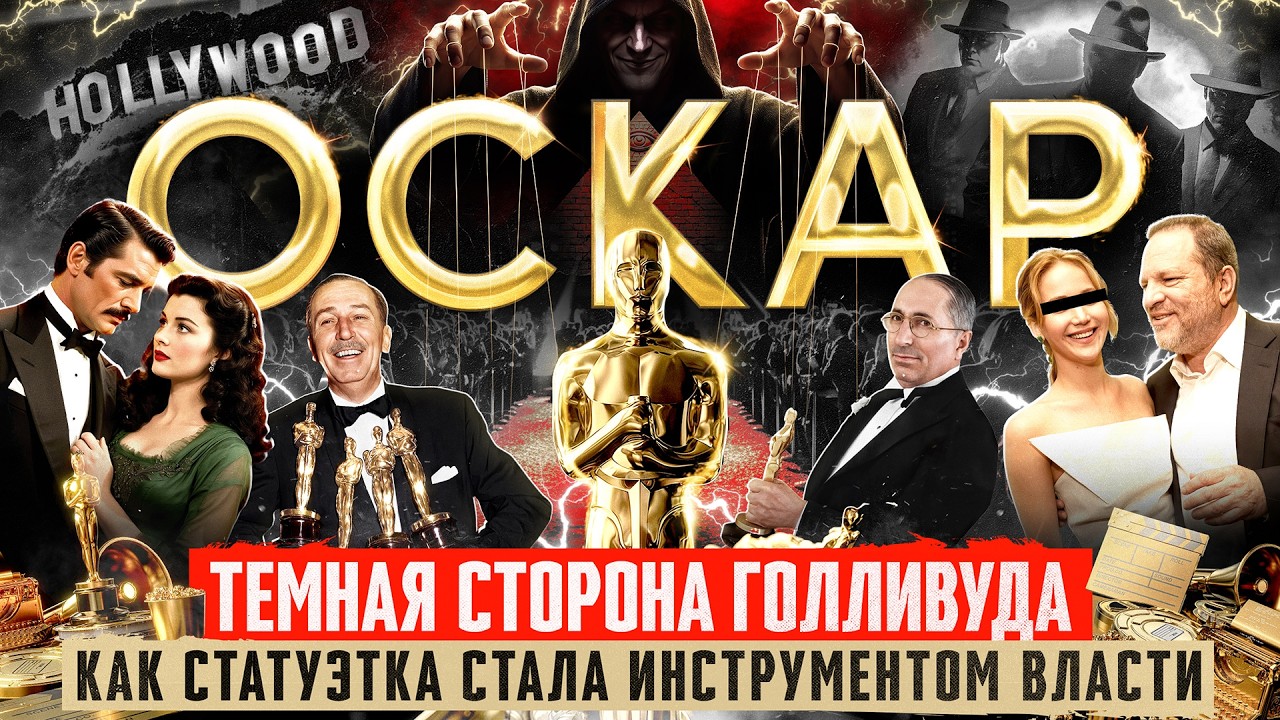
Summary preview
The Oscars: The Grand Dream Factory and Its Dark Secrets
Hello, friends! Today, we embark on a captivating, and at times truly chilling, journey through the world of Hollywood and its premier award – the Oscar. Prepare yourselves, because what you're about to see might shatter your perception of the "dream factory." This is a story not just about cinema, but about power, money, intrigue, the mafia, Freemasons, and, alas, the demise of countless talents.
Introduction: The Beginning of Hell for a Young Star
Imagine the year is 1938. Los Angeles. Fifteen-year-old Judy Garland, a girl from a modest theatrical family, seemingly receives a ticket to a happy life. She is chosen by Louis Mayer himself, the head of the giant Metro-Goldwyn-Mayer (MGM) studio, for the lead role in "The Wizard of Oz." Mayer is not just a studio head; he is a veritable god of the film industry, capable of elevating anyone to the pinnacle of fame or crushing their destiny. But for Judy, this was merely the beginning of hell. Six months of filming turned into torture: shifts of 18 hours, sometimes three days without sleep. And the diet? According to Mayer, Judy was to subsist solely on chicken broth, black coffee, cigarettes, and... pills. Yes, pills became the key element of her "success." Every day, the fifteen-year-old girl was given amphetamines to keep her from collapsing from exhaustion, and at night – barbiturates, so she could at least get some sleep. In the end, she received a special juvenile "Oscar" and signed a long-term contract with MGM. But this was just the beginning. Her entire future life belonged to the studio. This regimen continued for years, leading to suicide attempts and severe psychological problems. The studio wasn't interested in treatment – it was too long and interfered with filming. It was far more effective to keep Judy under threat of more radical treatment – electroshock therapy in a psychiatric hospital – to quickly return her to working condition after breakdowns.
Thesis 1: Hollywood as an Inhuman Machine
Judy Garland's case is not an exception, but the rule. Young Hollywood was an inhuman money-making machine. Stars were squeezed dry, forced to work without days off. Rapes of actresses by industry bosses were commonplace. Pregnant women were forced to undergo illegal abortions, and inconvenient people could simply be killed, disguised as suicides. Those who talked too much to the press were sent to psychiatric hospitals or even subjected to lobotomies. Actors died from toxic makeup, drug and alcohol overdoses, and stuntmen from dangerous stunts without insurance. To cover up this filth, studios bribed the press, police, and government. Special "fixers" buried bodies and even resolved problems when celebrities killed each other.
Thesis 2: The Oscar as a Tool of Control and Manipulation
Under pressure from the press and public, and due to workers' struggles for their rights, studios sought ways to maintain control. It was then that Louis Mayer conceived the idea of creating the Academy of Motion Picture Arts and Sciences, controlled by the studios, and holding the annual Oscar awards. His words were simple: "The best way to control movie people is to hang medals on them." The Oscar became a facade of respectability, hiding the most horrific atrocities.
Thesis 3: The Oscar as a Mirror of Society and Industry
The Oscar ceremony transformed from an industry award into a sacred ritual, an arena of scandals, political struggle, and simultaneously – a mirror of American cinema and society. It reflects not only the glamour but also the most unsightly dark sides, showing how cinema became a powerful tool for influencing people's minds.
Thesis 4: An Industry That Sells Reality
Hollywood learned to sell not just films, but versions of reality. Here, the mafia, studio bosses, actors, political strategists, and directors intertwine – all architects of mass thinking. Scandals, backroom deals, manipulation, normalization of violence – all of this happens under the glare of the red carpet spotlights.