
Summary preview
The Fatal Conceit: Unpacking Hayek's Masterpiece
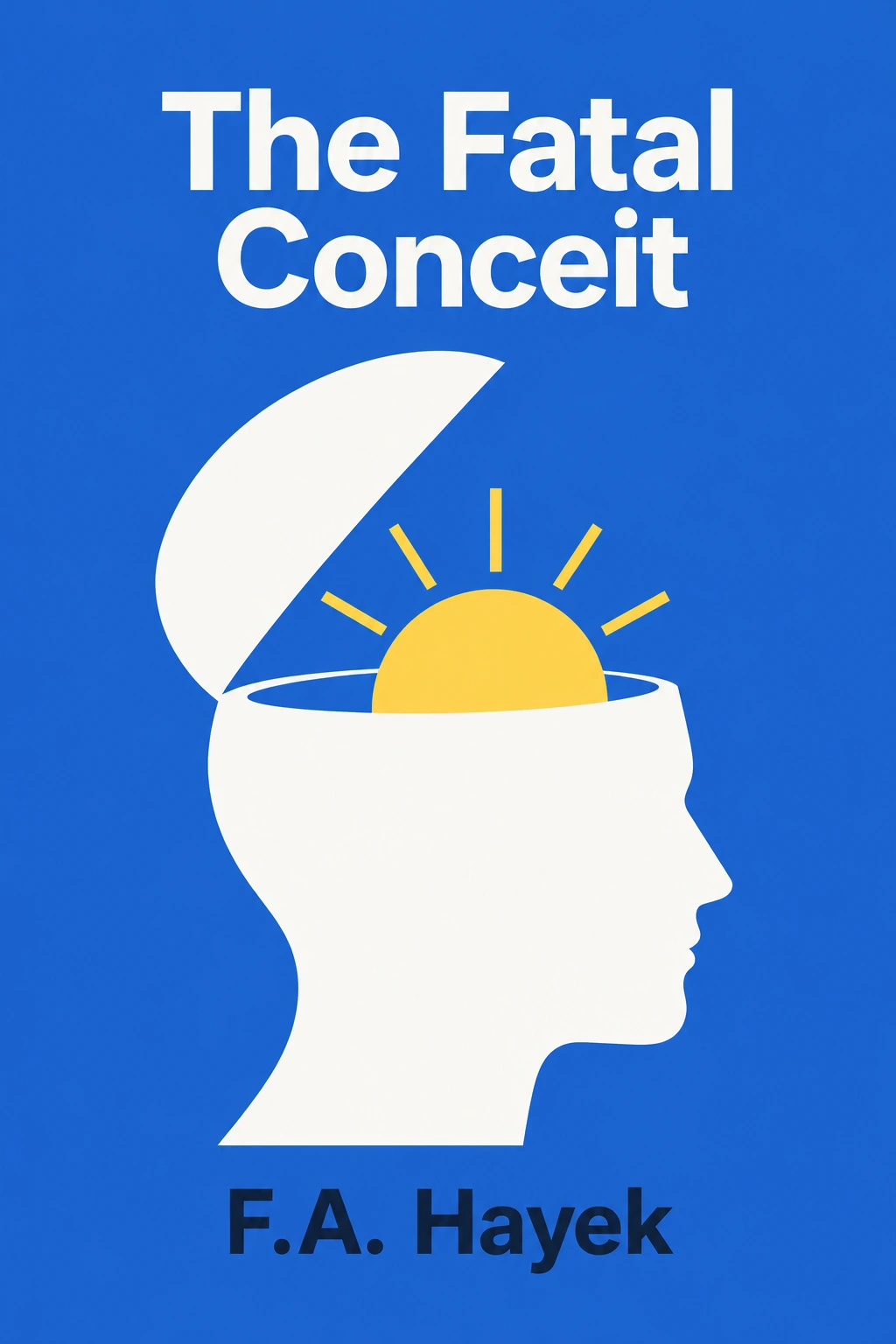
F.A. Hayek's "The Fatal Conceit" is a seminal work that challenges our understanding of society, economics, and the limits of human knowledge. Hayek argues that the greatest human error is the belief that we, as individuals or groups, can design and control complex social systems from the top down. He terms this the "fatal conceit," asserting that such attempts are doomed to fail because they ignore the fundamental truth of how societies function: through a complex, emergent order built on the dispersed knowledge of millions. This book explores the limits of human knowledge, the power of spontaneous order, and why attempts to engineer society according to a master plan are inherently flawed.
Section 1: Introduction - The Overconfident Planner
The book begins by confronting a pervasive human tendency: the desire to plan and control, particularly in politics and economics. Hayek observes that many brilliant minds believe they can design superior systems to those that have evolved organically. While well-intentioned, this impulse is fundamentally flawed due to a misunderstanding of the vast, unmanageable knowledge required to truly control complex systems like human societies. Every individual possesses unique, localized knowledge crucial to their own lives and, collectively, to society's functioning. No single person or committee can gather and process all this information. The "fatal conceit" is the arrogance of believing we can possess or direct all necessary knowledge, relying on abstract reason divorced from lived experience. Hayek contrasts this with spontaneous order, where complex patterns emerge naturally from individuals interacting based on simple rules, like in a marketplace or language. His introduction critiques central planning and defends decentralized, emergent orders, arguing that the top-down, knowledge-hoarding approach is the wrong method, leading to unintended consequences and failure.
Section 2: Main Theses - The Pillars of Hayek's Argument
Hayek's core arguments in "The Fatal Conceit" can be summarized by five interconnected theses: Thesis 1: The Limits of Human Knowledge Are Vast and Inescapable. Knowledge in complex societies is inherently dispersed, often unarticulated (tacit), and incomplete for any single mind or group. The most critical knowledge for societal functioning is the specific, ever-changing "knowledge of time and place"—who needs what, who can produce it, local conditions, and opportunities—which resides in the minds of millions. Centralizing this knowledge is practically impossible. Thesis 2: Spontaneous Order is the Foundation of Society, Not Design. Unlike designed mechanical systems, human societies evolve. Hayek calls this evolution spontaneous order. Complex structures like language, morals, markets, and legal systems emerge over time through countless individual interactions pursuing goals, guided by general rules and traditions. These emergent orders are complex and efficient because they incorporate dispersed knowledge, making them adaptive and resilient. Thesis 3: Central Planning Leads to Misallocation and Oppression. When governments attempt to plan economies or societies, they encounter insurmountable knowledge problems. This leads to misallocation of resources, unmet needs, and stifled innovation. Furthermore, such planning requires accumulating vast power, often resulting in coercion and suppression of individual liberty. The planner's conceit directly leads to these negative outcomes. Thesis 4: Abstract Rules and Traditions are Essential Guides. In the absence of detailed plans, Hayek emphasizes reliance on abstract rules and traditions. These are general principles or norms that guide behavior without dictating specific actions, such as property rights, the rule of law, or social etiquette. They provide a framework for individuals to use their own knowledge while maintaining orderly interaction. Traditions, built over generations, distill useful experience and knowledge. Thesis 5: The Evolution of Morality and Institutions is Key. The rules and institutions enabling spontaneous order are not static; they evolve. Societies thrive by developing mechanisms to discover and adopt rules and institutions conducive to human flourishing. This is a gradual process of trial, error, adaptation, and learning from experience, fundamentally different from the blueprint approach of central planners.
Section 3: Key Ideas - Digging Deeper into Hayek's Concepts
Hayek elaborates on several crucial concepts that underpin his argument: The Nature of Knowledge: Explicit vs. Tacit. Hayek distinguishes between explicit knowledge (facts and figures that can be written down) and tacit knowledge (know-how, intuition, practical understanding from experience). He argues that most knowledge relevant to society is tacit, deeply personal, context-specific, and difficult to centralize or transfer. Spontaneous Order vs. Made Order. Made order (taxis) is deliberately designed (e.g., a building). Spontaneous order (kosmos) emerges from individual actions without conscious design (e.g., market economy). Spontaneous order is often more complex and adaptive because it incorporates dispersed tacit knowledge. The Extended Order. This term describes the complex, large-scale social structures (markets, international trade, legal systems) that enable cooperation among strangers on a massive scale. This order evolved because its rules and institutions proved successful in allowing more people to survive and prosper. Its rules are often abstract, impersonal, and based on traditions that embody tested experience. The Role of Rules and Traditions. Abstract rules (rule of law, property rights) and traditions provide a predictable framework for individuals to use their knowledge. Traditions often embody valuable tacit knowledge essential for the extended order, and discarding them without understanding can be detrimental. The Danger of "Socialism" and "Rationalism." Hayek critiques "socialism" (the belief that society should be consciously organized for specific goals) and "constructivist rationalism" (the belief that human reason alone can reconstruct society). He argues these approaches embody the fatal conceit, assuming nonexistent knowledge and control, leading to inefficiency and loss of liberty. The Price System as an Information Mechanism. Hayek views prices not just as exchange values but as a vital communication system. Rising prices signal scarcity or increased demand, guiding producers and consumers. This signal instantaneously incorporates the knowledge of millions, a feat impossible for central planners.
Section 4: Practical Takeaways - How to Use These Ideas Today
Hayek's ideas offer practical guidance for navigating complexity: Embrace Humility About What You Know: Acknowledge the limits of your knowledge when facing complex problems. Ask questions, seek diverse perspectives, and recognize uncertainties. This fosters learning and avoids errors. Value Diverse Knowledge and Input: Actively seek and listen to opinions from people with different experiences. This taps into dispersed knowledge, leading to more robust solutions. Favor General Rules Over Specific Directives: Establish clear, general principles rather than overly detailed procedures. This empowers individuals to use their own knowledge and adapt, fostering efficiency and innovation. Be Skeptical of Grand, Top-Down Plans: Approach ambitious, sweeping solutions with caution. Question who has the necessary information and what knowledge is being ignored. Trust the Wisdom of Experience (Tradition and Evolution): Don't dismiss established practices solely because they seem old or irrational. Understand the underlying reasons for their development, as they often embody valuable tacit knowledge. Understand the Power of Price Signals: In any context of resource allocation, pay attention to signals of scarcity and demand. Respond to real-world information about value and scarcity. Applying these takeaways promotes more realistic and effective problem-solving by acknowledging knowledge limits and valuing adaptive, emergent systems.
Section 5: Key Quotes - Hayek's Words to Ponder
"The most fundamental issue of all is that the 'social sciences' are concerned with the regularities of the human actions, and that these actions are the results of human actions, but not of human design." "We must learn to do things in that order for which we do not know the reason." "The curious task of economics is to provide simple information of which most people have none, about the conditions of the world in which they live – information which nobody can ever bring together in one mental idea or image." "If you want to build a better society, you don't start by imposing your idea of a better society on others. You start by creating the conditions in which a better society can emerge." "The 'socialisation' of all activities which are the result of human action but not of human design is therefore only a pseudo-socialisation." These quotes highlight the core themes of spontaneous order, the limits of conscious understanding, the informational role of economics, and the dangers of imposing designs on emergent systems.