
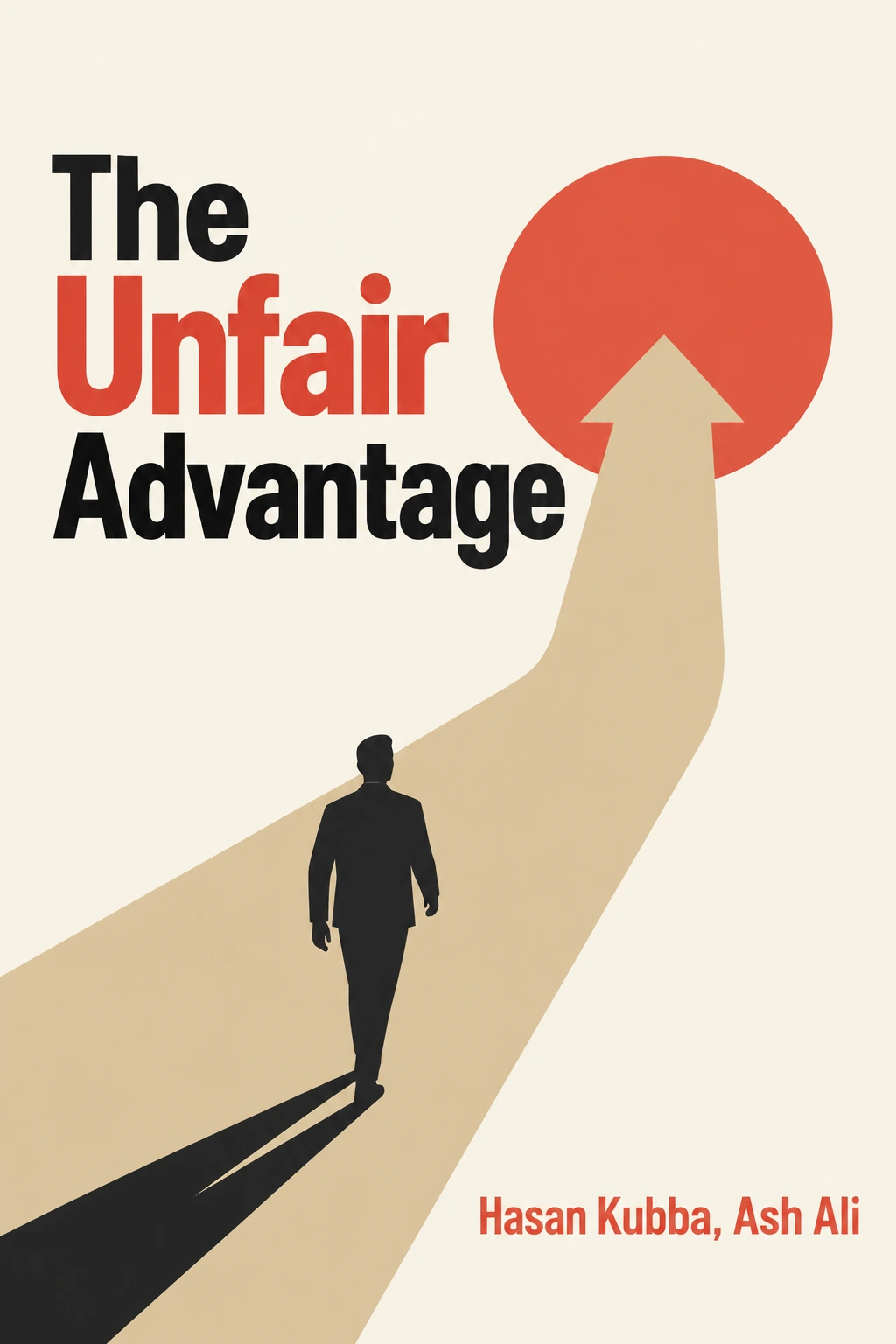
Summary preview
Unlocking Your Unfair Advantage: A Deep Dive with Hasan Kubba and Ash Ali
This book, 'The Unfair Advantage,' by Hasan Kubba and Ash Ali, is a practical guide to identifying and leveraging unique personal strengths for success, especially in business. It reframes the concept of an 'unfair advantage' not as cheating, but as inherent unique qualities and resources that give individuals a leg up. The authors emphasize that everyone possesses these advantages, often overlooking them because they come naturally. The book encourages self-reflection to shift focus from perceived lacks to existing assets.
Introduction: What's an 'Unfair Advantage' Anyway?
The term 'unfair advantage' is redefined as something unique to an individual that provides a competitive edge. This can stem from background, skills, network, or mindset. The authors argue that these advantages are often taken for granted and encourage readers to recognize their inherent strengths rather than focusing on perceived weaknesses. The core idea is to shift from 'what am I lacking?' to 'what do I already possess?'
Main Theses: The Pillars of Your Unfair Advantage
The book is structured around five core theses that form the foundation of an unfair advantage: Thesis 1: Your Background is Your Foundation: Emphasizes that upbringing, education, family, culture, and past experiences are not limitations but sources of unique insights and skills. These formative experiences shape potential superpowers. Thesis 2: Money is a Tool, Not the Only Goal: While financial resources are an advantage, the book focuses on how money is used. It also highlights that resourcefulness and smart financial planning can be equally powerful, and a 'poverty mindset' is a significant disadvantage. Thesis 3: Education is More Than Degrees: Defines education broadly, including formal schooling, self-directed learning, skills acquired through experience, mentorship, and continuous curiosity. It's about the depth, breadth, and application of knowledge. Thesis 4: Your Network is Your Net Worth (and More): Focuses on the value of genuine relationships and mutual support within a network. It's about who you know and the collaborative potential this offers, emphasizing giving value as much as receiving it. Thesis 5: Your Mindset is Your Multiplier: Identifies mindset as the most crucial advantage, encompassing beliefs, attitudes, resilience, creativity, and risk-taking. A positive, growth-oriented mindset amplifies all other advantages.
Key Ideas: Digging Deeper into the Concepts
Beyond the main theses, the book explores several key ideas: The 'Founders' Mentality' vs. The 'Employee Mentality': Contrasts a proactive, ownership-driven approach with a passive, instruction-following one. A founders' mentality is about taking initiative and solving problems creatively. Identifying Your 'Hidden Advantages': Provides practical methods for uncovering overlooked strengths, such as things done easily, compliments received, past successes, unique experiences, and passions. The Power of Compounding: Analogous to financial compounding, advantages can grow over time through consistent application, opening new opportunities and enhancing other skills. The 'Growth vs. Fixed' Mindset Revisited: Strongly advocates for a growth mindset (abilities are developable) over a fixed mindset (abilities are innate) as a prerequisite for building and utilizing advantages. Building 'Momentum': Encourages creating a positive feedback loop where small wins lead to bigger opportunities, driven by consistent action and leveraging advantages.
Practical Takeaways: Putting it All Together
The book offers actionable advice for applying these concepts: Conduct Your 'Unfair Advantage Audit': A systematic self-assessment across advantage categories, including seeking feedback from others, to identify top 1-3 potent advantages. Focus and Amplify: Concentrate on enhancing identified core advantages rather than trying to develop all of them. Seek complementary strengths through collaboration. Reframe Your 'Disadvantages': Challenge negative self-perceptions and look for the upside in perceived weaknesses, embracing one's unique story. Build Your 'Inner Circle': Focus on cultivating high-quality, supportive relationships within your network. Take Action, Even Small Steps: Emphasizes starting with small, achievable goals, experimenting, iterating, and being consistent to build confidence and momentum.
Key Quotes: Words to Live By
"Your unfair advantage is not about having a leg up on others in a race you didn’t choose. It’s about recognizing the unique combination of factors that give you a distinct edge, and then deliberately and strategically amplifying them." "Stop trying to fix your weaknesses and start doubling down on your strengths." "The most powerful advantage you can have is the ability to learn, adapt, and grow faster than everyone else." "Your background isn't a limitation; it's a launchpad."