
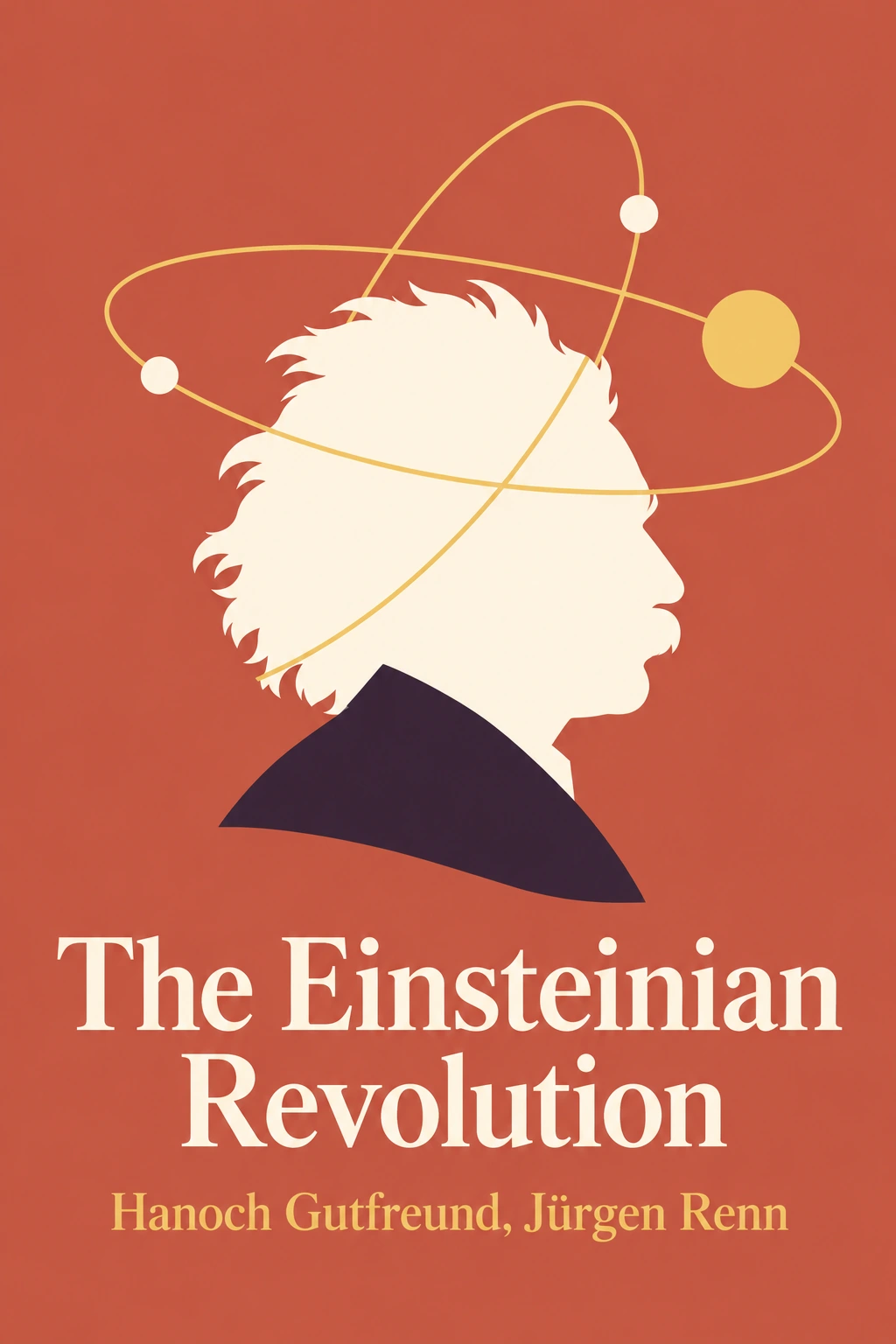
Summary preview
The Einsteinian Revolution: More Than Just a Genius's Leap The book 'The Einsteinian Revolution' by Hanoch Gutfreund and Jürgen Renn challenges the myth of Albert Einstein as a solitary genius who invented relativity out of thin air. Instead, it argues that his revolutionary ideas were the culmination of a century-long, evolutionary process within physics. The authors emphasize that understanding modern physics requires appreciating the historical context and the gradual development of scientific knowledge, rather than viewing Einstein's breakthroughs as isolated events. Einstein's revolutionary ideas were not sudden inventions but the result of a long evolutionary process in physics. The book debunks the myth of Einstein as a lone wolf genius. Understanding modern physics necessitates understanding its historical development. Einstein's work built upon, challenged, and transformed classical physics. His discoveries led to the creation of Quantum Physics and General Relativity. Einstein was troubled by the incompatibility of these two frameworks and sought a unified theory. The popular image of Einstein as an eccentric, solitary genius is contrasted with the reality of his deep engagement with the scientific community and existing knowledge. Gutfreund and Renn highlight that Einstein was influenced by contemporary scientific puzzles and debates, such as the Michelson-Morley experiment and Maxwell's equations. His work in 1905, his 'miracle year,' directly addressed paradoxes within classical physics, such as the nature of light and the constancy of its speed, leading to Special Relativity. This theory resolved conflicts between Newtonian mechanics and electromagnetism by proposing that space and time are relative and intertwined. The 'lone genius' narrative is a simplification; Einstein was deeply engaged with his contemporaries. He responded to existing scientific problems and paradoxes. Key influences included the Michelson-Morley experiment and Maxwell's equations. Einstein's 1905 papers addressed issues in classical physics. Special Relativity resolved conflicts by positing a constant speed of light and relative space/time. Einstein's work, alongside the concurrent development of quantum theory by scientists like Planck, Bohr, and Heisenberg, fundamentally reshaped physics, leading to two major frameworks: General Relativity and Quantum Physics. General Relativity describes gravity not as a force, but as the curvature of spacetime caused by mass and energy, explaining phenomena from falling apples to black holes. Quantum Physics, on the other hand, deals with the subatomic realm, characterized by superposition, entanglement, and probabilistic outcomes, overturning the deterministic view of classical physics. These two theories are highly successful in their respective domains but represent distinct understandings of reality. Modern physics is characterized by two main frameworks: General Relativity and Quantum Physics. General Relativity: