
Summary preview
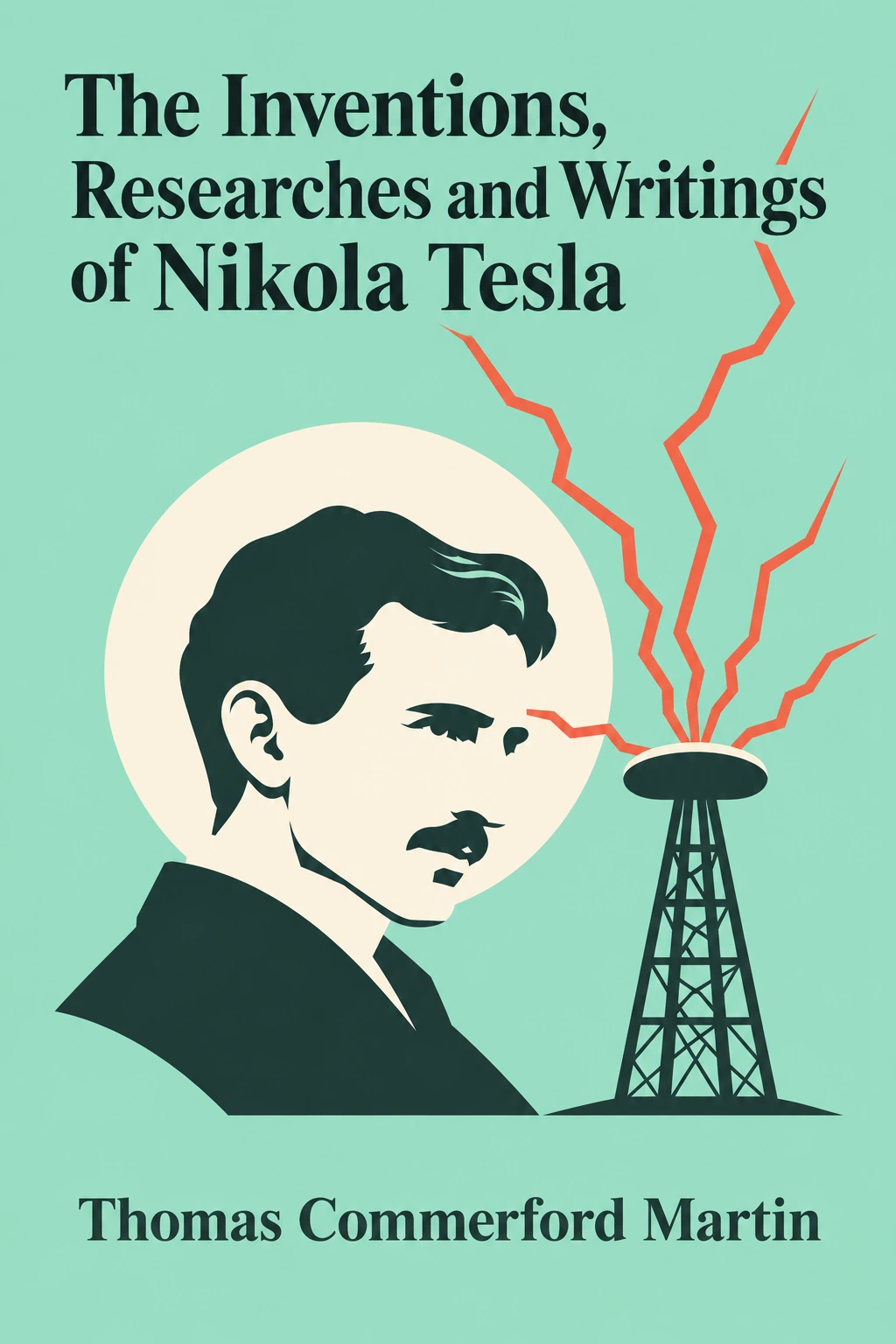
Unpacking the Genius of Nikola Tesla: A Journey Through His Inventions and Writings This summary delves into Thomas Commerford Martin's "The Inventions, Researches and Writings of Nikola Tesla," offering a comprehensive look at Tesla's revolutionary contributions, particularly his work around 1894. The focus is on his groundbreaking developments in polyphase currents and high-potential lighting, which form the basis of modern electrical systems. The Man Behind the Sparks: A Glimpse into Tesla's World Nikola Tesla, born in 1856, was a Serbian-American inventor with an extraordinary capacity for visualization and a deep fascination with electricity. His early education and career in Europe exposed him to the inefficiencies of Direct Current (DC) systems, fueling his determination to develop a superior alternative. His move to the United States in 1884 and initial work with Thomas Edison highlighted their fundamental disagreement on AC versus DC, with Tesla championing AC for its superior voltage-transforming capabilities, essential for long-distance transmission. Tesla was known for his intense focus, unique habits, and a flair for dramatic demonstrations, which helped capture public imagination and secure support for his ambitious projects. His genius lay not just in conceiving devices but in understanding and harnessing fundamental electrical principles on a grand scale. The Revolution of Polyphase Currents: The Heart of Tesla's AC System Tesla's most significant contribution is the polyphase current system, particularly the three-phase system, which revolutionized electrical power. Unlike DC, AC voltage can be easily altered using transformers. Polyphase systems use multiple AC currents, out of sync, to create a continuous, rotating effect. This system offered several game-changing advantages: 1. Efficient Long-Distance Transmission: High AC voltages, achieved through transformers, minimize energy loss during transmission, allowing power plants to be located far from consumption centers. 2. Simpler, More Efficient Motors: Polyphase currents enabled the creation of the Tesla rotating magnetic field, leading to simpler, more robust, and maintenance-free AC induction motors. 3. Power Generation and Distribution: The system simplified generator and transformer designs, making the entire electrical infrastructure scalable and adaptable. Tesla's vision was holistic, encompassing generators, transformers, transmission lines, and motors, addressing all shortcomings of existing DC systems and enabling the electrification of cities and industries. The Magic of the Rotating Magnetic Field The rotating magnetic field, a direct consequence of polyphase currents, is central to Tesla's AC induction motor. By feeding out-of-sync currents into coils, Tesla created a magnetic field that smoothly rotates. This field induces currents in the rotor of the motor, causing it to spin without direct electrical connection (like brushes or commutators). This simplicity