
Summary preview
The Infinite Journey of the Book: A Deep Dive into Irene Vallejo's "Infinity in a Reed"
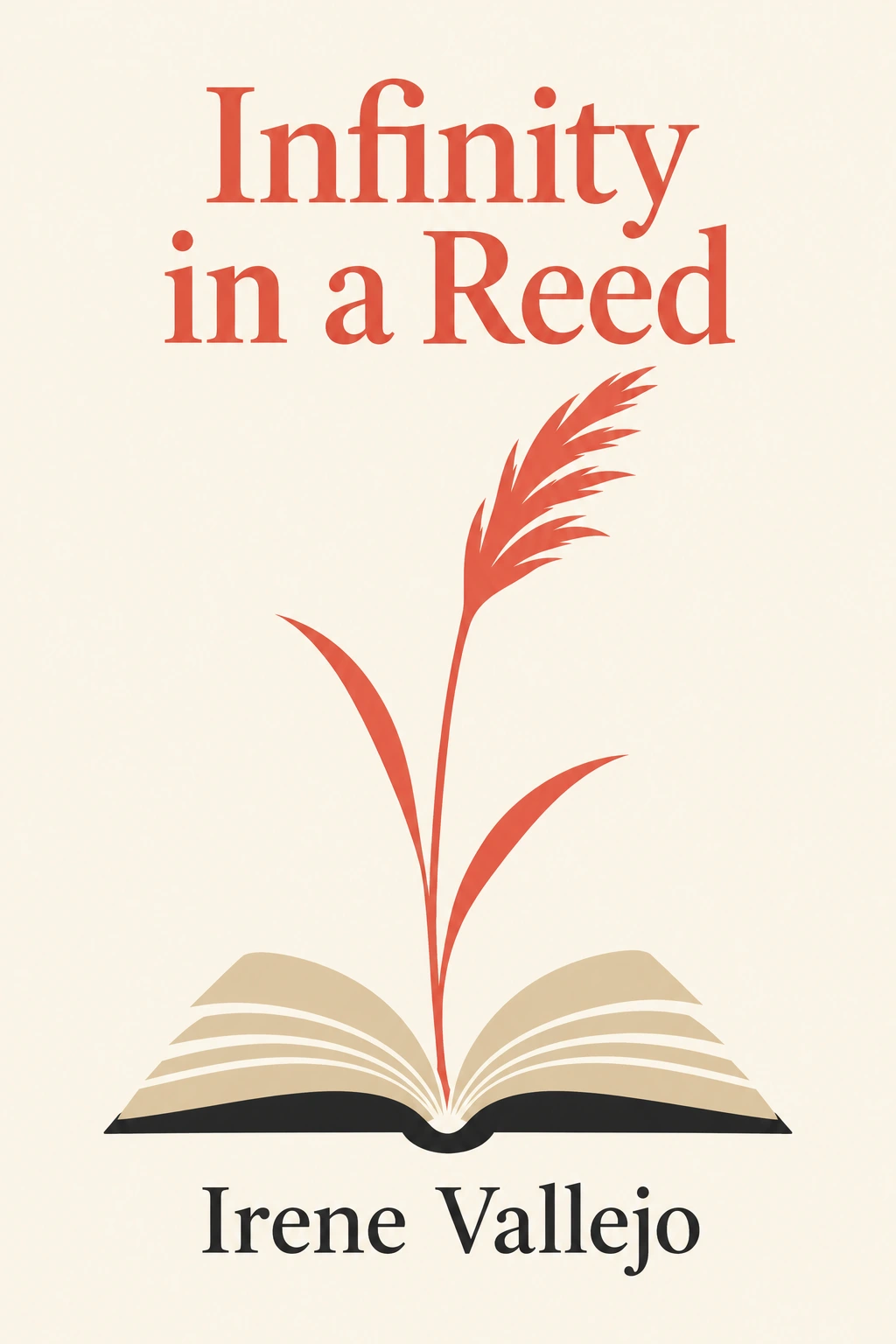
Irene Vallejo's "Infinity in a Reed" is a vibrant exploration of the book's enduring legacy. It chronicles its evolution from ancient origins to the digital age, highlighting the unsung heroes, the challenges of preservation, and the profound impact of the written word on human civilization. The book emphasizes that every interaction with a book connects us to a vast, ongoing human endeavor of preserving and sharing knowledge.
Section 1: The Birth of the Book - From Reed to Scroll
The book's journey began with the abundant reeds of the ancient Near East. The pith of these reeds was transformed into papyrus, a revolutionary medium for recording thoughts and stories, moving them beyond fleeting speech. This painstaking craft created a precious commodity. The dominant early format was the scroll, a long, rolled document requiring active, two-handed engagement. This linearity influenced storytelling and argumentation. The ability to record and store information permanently marked a fundamental shift in human consciousness, enabling knowledge accumulation and complex societies. Early libraries, like the ambitious Library of Alexandria, symbolized this ambition to gather all knowledge, yet demonstrated its inherent fragility. Scribes, the often-anonymous workers who meticulously copied texts, were crucial, though underappreciated, engines of this dissemination. The book's origin story establishes it as a dynamic entity, born from nature and shaped by human ingenuity, constantly evolving.
Section 2: The Rise of the Codex - A Revolution in Reading
The codex, the ancestor of the modern book, represented a significant revolution. Its stacked, bound pages offered advantages over the scroll: greater space efficiency (writing on both sides), portability, and crucially, accessibility. Flipping directly to specific pages made referencing and studying far easier, a major boon for scholars. While initially met with some resistance from those accustomed to scrolls, early Christian communities embraced the codex for its practicality in compiling texts and spreading teachings. The codex's durability, compactness, and user-friendliness facilitated its eventual dominance, paving the way for features like tables of contents and indexes. This format shift democratized access to books, making them more portable and usable for a wider audience. The codex fundamentally redesigned our interaction with information, fostering new forms of analysis and a more interactive relationship with texts.
Section 3: The Perils of Preservation - Libraries, Fires, and Forbidden Texts
Preserving written knowledge has always been a precarious endeavor. Libraries, the primary repositories, were vulnerable to fire, decay, and neglect. The loss of a library meant the erasure of history and the silencing of voices. Beyond natural threats, human-driven censorship and destruction, fueled by ideology and power, posed a significant danger. Books, carrying powerful ideas, were often banned, burned, or destroyed by authorities seeking to control thought and narratives. However, human ingenuity and resilience shone through. People hid manuscripts, smuggled texts, and rewrote them from memory. Acts of quiet defiance, like those of scribes in monasteries preserving classical texts or the clandestine circulation of 'underground libraries,' kept knowledge alive through challenging times. Every surviving book is a testament to the continuous struggle against oblivion and the dedication of those who fought to preserve it.
Section 4: The Book as Commodity - Trade, Power, and the Economy of Words
Books have always been intertwined with economics, trade, and power. From the valuable papyrus scrolls and skilled scribes of antiquity, access to books was often limited to the elite. The invention of the printing press dramatically altered this landscape. Mass production made books more affordable and accessible, fueling literacy and creating new industries around printing, publishing, and bookselling. This commercialization, however, brought challenges like debates over intellectual property and quality control. The book trade became a significant economic activity, fostering cultural diffusion through trade networks. Control over the presses granted immense power to influence public opinion and disseminate ideologies. The funding and evolution of libraries also reflected changing economic and social structures. Even today, the economics of book production and distribution continue to evolve, demonstrating that access to knowledge is mediated by economic realities.
Section 5: The Reader's Role - From Solitary Act to Collective Experience
Vallejo emphasizes the reader's active role in bringing a book to life. Reading, far from being passive, is a dynamic and creative act. While early reading was often public and oral, the codex facilitated private, solitary reading, fostering a deeper, personal connection. Marginalia reveal readers interacting directly with texts, creating dialogues across time. A book's meaning is completed in the reader's mind, with each individual interpreting it through their unique experiences. Readers become conduits, sharing knowledge and ideas, forming crucial informal networks for cultural dissemination. Authors themselves are often avid readers, their work influenced by their reading experiences, blurring the lines between consumption and creation. Different eras have cultivated distinct reading practices, with the rise of the novel creating new types of readers. The reader is celebrated as an essential partner, igniting imaginations and realizing the written word's potential.