
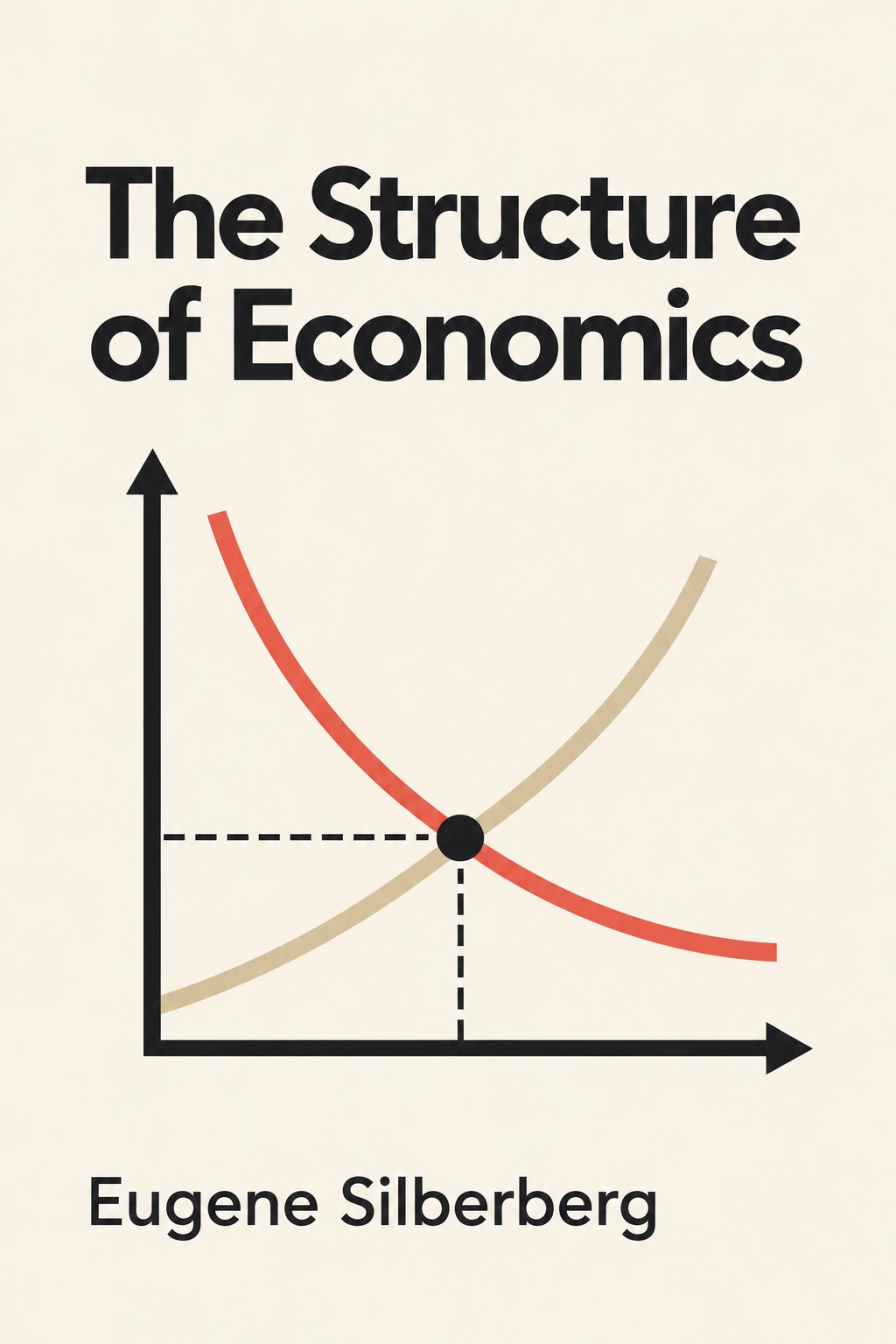
Summary preview
Diving Deep: A Journey Through Advanced Microeconomics and Mathematical Economics
This resource is designed for those seeking to deepen their understanding of economics, particularly graduate students, advanced undergraduates, and enthusiasts of mathematical economics. It offers a rigorous and comprehensive exploration of the intricate machinery that drives economies, focusing on complex interactions and contemporary issues.
The Big Picture: Why This Book Matters
Economics, at its core, studies choices under scarcity. Mathematical economics and advanced microeconomic theory provide the precise language and framework to model these complex decisions and their large-scale implications. This book bridges abstract theory with practical realities, equipping readers with analytical tools to dissect economic phenomena, predict outcomes, and potentially design better economic systems. It is valuable for academics, professionals, and anyone interested in the global economy.
Bridging Theory and Application
The resource connects abstract mathematical models to fundamental microeconomic principles like consumer choice, producer behavior, market equilibrium, and welfare. Expressing economic relationships mathematically allows for precise analysis using calculus and optimization, moving economic analysis beyond guesswork to a rigorous science.
The Importance of Rigor
Rigor—precision in definitions, logical arguments, and assumptions—is paramount in advanced economics. Mathematical economics provides the framework for this rigor, ensuring clarity, unambiguity, and logical soundness, which is crucial for complex topics where intuition might mislead. The book challenges readers to think critically and analytically, fostering mastery of tools for building robust models and deriving meaningful insights.
A Foundation for Further Study
A solid grounding in mathematical economics is essential for graduate studies and advanced research in economics. This book lays the groundwork for specialized courses and research by introducing key mathematical techniques and economic concepts. It's also beneficial for non-academics, such as policymakers and financial analysts, who need a deep understanding of economic principles.
The Core Pillars: Microeconomics Meets Mathematics
This work explores the synergy between microeconomic theory and mathematical economics, where mathematical structures often embody economic principles. Microeconomics focuses on fundamental building blocks: individual choices, firm production and sales, and market interactions. Mathematical economics expresses these concepts precisely, enabling sophisticated models that capture nuances beyond verbal descriptions.