Summary preview
Einstein: Genius, Dreamer, and Rebel – A Deep Dive
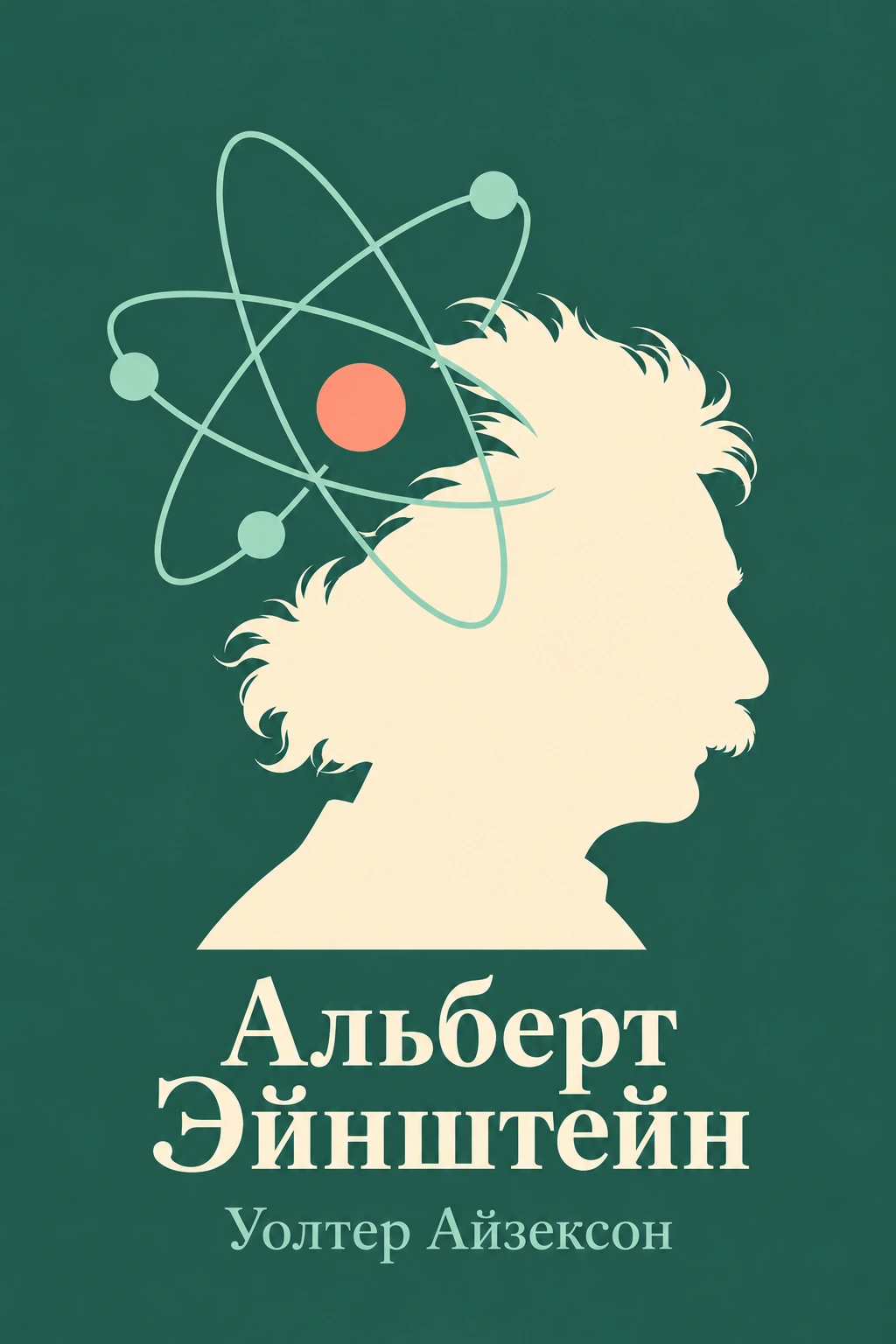
Hello! Today, we're embarking on a fascinating journey through the life of one of humanity's most brilliant minds – Albert Einstein. You know who he is, right? The guy with the wild hair and the famous formula E=mc². But Walter Isaacson's book, the author of that Steve Jobs biography many of us devoured, shows us a completely new side of Einstein. This isn't just a physics textbook wrapped in a biography, nor is it a dry chronology of a life. No, this is a true exploration of a genius's soul, written in a way that will be interesting and understandable even if you're far from science. Isaacson doesn't just retell facts. He digs deep, using letters, diaries, and the memories of friends and colleagues. And you know what's coolest? He manages to explain complex scientific ideas so that you start to understand them. It's like having someone explain quantum physics to you over coffee with a friend, without any jargon. He also paints a portrait of Einstein – not just as a genius, but as a human being. A dreamer who could spend hours lost in thought, a rebel who wasn't afraid to go against the grain, a humanist who cared about the fate of the world, and a thinker whose ideas still make us ponder today. So, if you thought you knew Einstein – get ready to be surprised. And if you're just starting to get acquainted with him, this book is the perfect start. Let's break it all down, as if we were flipping through this book ourselves and discussing it.
Chapter 1: The Boy Who Asked "Silly" Questions
Imagine little Albert. He wasn't a child prodigy in the classic sense. He didn't exactly excel at school. He even started speaking late, which greatly worried his parents. Teachers considered him slow, unsociable, and a bit odd. But inside this "slow" boy beat the heart of an explorer. He was incredibly curious. Remember how he was given a compass as a child? This simple toy left an indelible impression on him. How did the needle always point in one direction, no matter how you turned the box? It was the first hint that there were invisible forces in the world that governed everything. It was the beginning of his journey to understand the fundamental laws of nature. Then there was the incident with Euclid's book, "Elements." For Albert, it was like a revelation. He saw that the truth of statements could be proven using logic and axioms. This showed him the beauty and power of rational thinking. He began to study mathematics, physics, and philosophy on his own. He read Kant, Spinoza, Hume. He didn't just absorb information; he processed it, contemplated it, and asked questions. He wasn't afraid that his questions might seem silly. On the contrary, it's often such "silly" questions that lead to the most important discoveries. Like, what would happen if you traveled alongside a beam of light? This thought experiment, one of his favorite techniques, eventually led to the creation of the special theory of relativity. Isaacson emphasizes that such development was possible thanks to the support of his family, especially his mother, who encouraged his interest in music (he played the violin beautifully!), and his father, who introduced him to the world of science through books and instruments. But the most important thing was his inner fire, his unquenchable desire to understand how the world worked. He wasn't seeking grades or praise; he was seeking knowledge. This approach – learning for learning's sake, for the joy of the process of discovery – is something we can learn from him. In an era where everything is measured by results and rankings, Einstein reminds us of the value of pure curiosity.
Why Is This Important for Us?
Think about the last time you asked yourself a "silly" question that had no direct relation to your work or daily tasks. When did you start exploring something new just out of curiosity? Often, we're afraid of appearing ignorant, so we stop asking questions. Yet, it's precisely in these questions, in that childlike "why?", that lies immense potential for growth and discovery. Einstein shows us that it's important not to be afraid of being incompetent in something new, but rather to use it as a starting point for exploration. And one more thing: his passion for music. It wasn't just a hobby. Music helped him think, freed his mind, and allowed him to find unconventional solutions. So, if you think creativity and science are separate worlds, Einstein proves otherwise. Art and science nourish each other.
Chapter 2: The Rebel Who Disliked Authority
Einstein was never an easy person. He didn't fit into boxes. At school, he was considered a "difficult" child because he didn't blindly accept everything his teachers told him. He argued, doubted, and sought his own proofs. This trait stayed with him his entire life. He respected knowledge, but not blind obedience to authority. He believed that everyone should think for themselves. This applied not only to science but also to politics, society, and religion. He openly criticized the education system, which, in his opinion, stifled creativity and encouraged rote memorization. His famous quote: "The school system, in the end, destroys the sense of wonder and creative impulse, which is the most valuable gift nature bestows on man." He himself was expelled from the gymnasium in Munich for refusing to comply with demands and eventually finished school in Switzerland, where the system was more liberal. This rebellious spirit also manifested in his personal life. He wasn't afraid to go against social norms. For example, his relationship with his first wife, Mileva Marić, was complicated. She was a talented physicist, but their marriage broke down, and Einstein, despite having children, didn't give her the attention she deserved. Isaacson doesn't idealize his hero; he shows his human weaknesses and complex character traits. But even in these difficult moments, we see a person who placed truth and his convictions above convenience and accepted rules. In politics, he was also a nonconformist. Being Jewish, he keenly felt the rise of anti-Semitism in Germany. He was a staunch pacifist but understood the necessity of fighting Nazism. His position was complex and often controversial. He didn't join any political parties, remaining an independent thinker. He believed in the power of reason and humanism but saw how these values could be trampled. His famous refusal to become President of Israel in 1952 is also a manifestation of this independence. He said he lacked the natural talent and experience for such a position. He believed his strength lay in science, not politics. This shows his deep understanding of his strengths and limitations, as well as his humility, despite his global fame.
How Does This Apply to Us?
How many times have we agreed with something simply because "that's how it's done" or "everyone does it"? How many times have we been afraid to express our opinion, fearing judgment or conflict? Einstein teaches us the courage to be ourselves, even if it means going against the current. This doesn't mean being stubborn and not listening to others. No, it means having your own opinion, based on reflection, and not being afraid to defend it. This also applies to our work. Often, we're afraid to propose new ideas if they differ from accepted standards. But it's precisely these ideas that can lead to breakthroughs. We need to find a balance between respecting experience and being open to innovation. And, of course, it's important to understand our strengths. We shouldn't try to do everything; it's better to focus on what we do best. This is not a sign of weakness, but a sign of wisdom.
Chapter 3: The Man Who Saw the World Differently (Science and Imagination)
Here we come to the most important part – Einstein's scientific ideas. But Isaacson does it in a way that doesn't make you feel like you're in a university lecture hall. He shows how these ideas were born from his unique view of the world, from his ability to visualize, from his play with imagination. Photons and the Quantum Leap: Did you know that Einstein received the Nobel Prize not for the theory of relativity, but for explaining the photoelectric effect? This is when light knocks electrons out of metal. Einstein proposed that light isn't just a wave, but a stream of particles – photons. Each particle carries a specific amount of energy. This was revolutionary! It helped lay the foundation for quantum mechanics, although Einstein himself struggled to accept some of its conclusions later, especially the idea of probability and uncertainty. He said, "God does not play dice." He believed in the fundamental order of the Universe, that everything could be explained if one dug deep enough. Special Theory of Relativity (STR): Remember when we talked about traveling alongside a beam of light? Einstein concluded that the speed of light in a vacuum is the absolute speed limit in the Universe. And that time and space are not constant, as we're used to thinking. They are relative and depend on the observer's speed. The faster you move, the slower time passes for you, and the shorter objects become in the direction of motion. This sounds like science fiction, but it's been confirmed by experiments! The formula E=mc² also comes from here. It shows that mass and energy are two sides of the same coin. A small mass can be converted into a huge amount of energy (as in nuclear reactions), and vice versa. General Theory of Relativity (GTR): This is an even more mind-boggling theory. Einstein realized that gravity isn't just a force that pulls objects together. It's the curvature of spacetime by massive objects. Imagine a stretched rubber sheet. If you place a heavy ball on it, the sheet will sag. If you then roll a small ball across it, it will roll towards the big ball, following the curvature. That's how, according to Einstein, planets orbit the Sun – they move along "grooves" carved into curved spacetime. This theory explained many phenomena that old physics couldn't, such as anomalies in Mercury's orbit. And it predicted things like black holes and gravitational waves, which were discovered much later. Isaacson emphasizes that Einstein wasn't just a brilliant mathematician. He was a visionary. He used "thought experiments" to imagine how objects behave in extreme conditions. He drew pictures, imagined himself flying on a beam of light. It was a play of imagination that allowed him to go beyond what could be observed and measured in his time. He said, "Imagination is more important than knowledge. Knowledge is limited. Imagination encircles the world, stimulating progress, giving birth to evolution."