
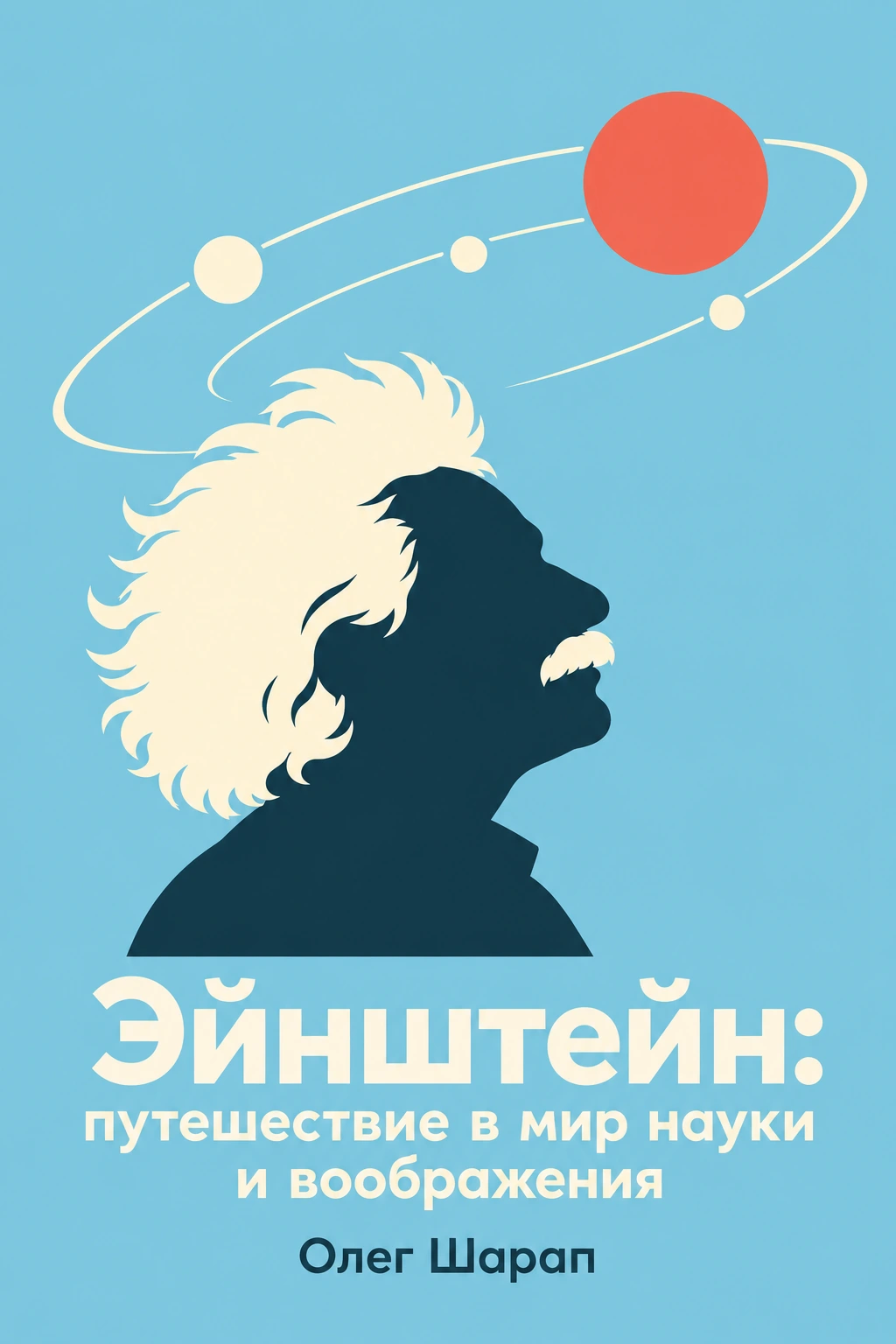
Summary preview
Journey into Einstein's World: The Genius Who Changed Everything
Hey there! Today, I want to share some thoughts about a book that dives deep into the amazing life and brilliant discoveries of Albert Einstein. You know, this isn't just another biography of a stuffy old scientist. The author tells the story so brilliantly that it feels like you're sitting right there with Einstein, sipping tea and contemplating the universe. It’s a journey that makes you feel like you're getting to know the man behind the iconic hair and the world-changing equations.
Introduction: Meeting the Legend
Picture this: a person whose ideas still make us scratch our heads, wondering how on earth he came up with them. That's Albert Einstein – a name that has become synonymous with genius itself. This book invites us on a journey through his life, starting from his earliest days as a curious young boy right up to his status as one of the most influential minds of the 20th century. The author wisely avoids drowning us in complex formulas. Instead, they take these cosmic concepts and literally break them down into simple, digestible pieces, using examples from our everyday lives. It’s like explaining how an engine works by comparing it to a bicycle – it sounds complicated, but suddenly, it clicks. The book's goal isn't just to chronicle Einstein's scientific achievements, but to show how his thoughts, his philosophy, and even his personal life impacted the world around him, and how they continue to do so. Ready to dive in?
Main Theses: What Made Einstein So Special?
The book builds its narrative around several core ideas that highlight what makes Einstein so remarkable and his contributions to science so monumental. Revolutionizing Our Understanding of Space and Time: Perhaps his most famous contribution is his theories of relativity. We tend to think of time as ticking uniformly for everyone and space as a static backdrop for events. Einstein, however, revealed a much more complex and fascinating reality. He showed that time can actually slow down, and space can warp and bend, all depending on speed and gravity. Imagine suddenly realizing your watch runs slower when you're sprinting incredibly fast, or that the floor beneath you can sag under the weight of a refrigerator! These concepts completely upended Newtonian physics and paved the way for understanding black holes, the expansion of the universe, and so much more. Energy and Mass: Two Sides of the Same Coin: The iconic formula E=mc² is also his brainchild. It tells us that mass and energy are fundamentally the same thing, just in different forms. A tiny amount of mass can transform into a colossal amount of energy (hello, atomic bomb, though Einstein himself opposed its use), and vice versa. This discovery became the bedrock of nuclear physics and fundamentally altered our perception of matter. Quantum Mechanics and the Element of Chance: While Einstein made significant contributions to the nascent field of quantum theory (like his Nobel Prize-winning explanation of the photoelectric effect), he struggled to accept its probabilistic nature. His famous quote, “God does not play dice,” reflects his deep-seated desire to find underlying, deterministic laws governing the universe. He believed that beneath the apparent randomness lay a more profound order that we hadn't yet uncovered. Einstein as a Philosopher and Humanist: The book emphasizes that Einstein was more than just a brilliant physicist; he was a profound thinker who pondered the meaning of life, war, peace, freedom, and society. He was a vocal advocate for peace, an opponent of racism and discrimination, and used his considerable fame to champion humanistic ideals. His views on religion, ethics, and the role of science in society continue to spark debate and intrigue.
Key Ideas: Digging Deeper into the Details
Let's delve a bit deeper into some of the most captivating points the book explores.
Idea 1: Imagination Trumps Knowledge
Einstein famously said, “Imagination is more important than knowledge. For knowledge is limited, whereas imagination embraces the entire world, stimulating progress, giving birth to evolution.” This idea is pure gold! It underscores that no textbook or formula can replace the power of dreaming, visualizing, and asking those crucial “what if?” questions. It was precisely his rich imagination that allowed him to envision what the world would look like if you were traveling alongside a beam of light. This ability to think beyond existing knowledge enabled his revolutionary discoveries. In our own lives, this means we shouldn't get stuck solely on what's already known. We must constantly seek new paths, brainstorm unconventional solutions, even if they seem outlandish at first glance.
Idea 2: Simplicity is the Hallmark of Genius
As I mentioned, the author does an incredible job of explaining complex topics. This, in itself, reflects Einstein's genius – his knack for distilling the essence of the most challenging concepts into simple language. His famous analogies, like the twin paradox (where one twin travels into space on a fast rocket and returns to find his Earthbound twin has aged significantly more), help us grasp the core of relativity. This teaches us that if you truly understand something deeply, you can explain it to anyone. Conversely, if you can't explain it simply, perhaps you don't fully grasp it yourself. This applies not just to science but to any area of life – whether it's work, study, or explaining something to a child.