
Summary preview
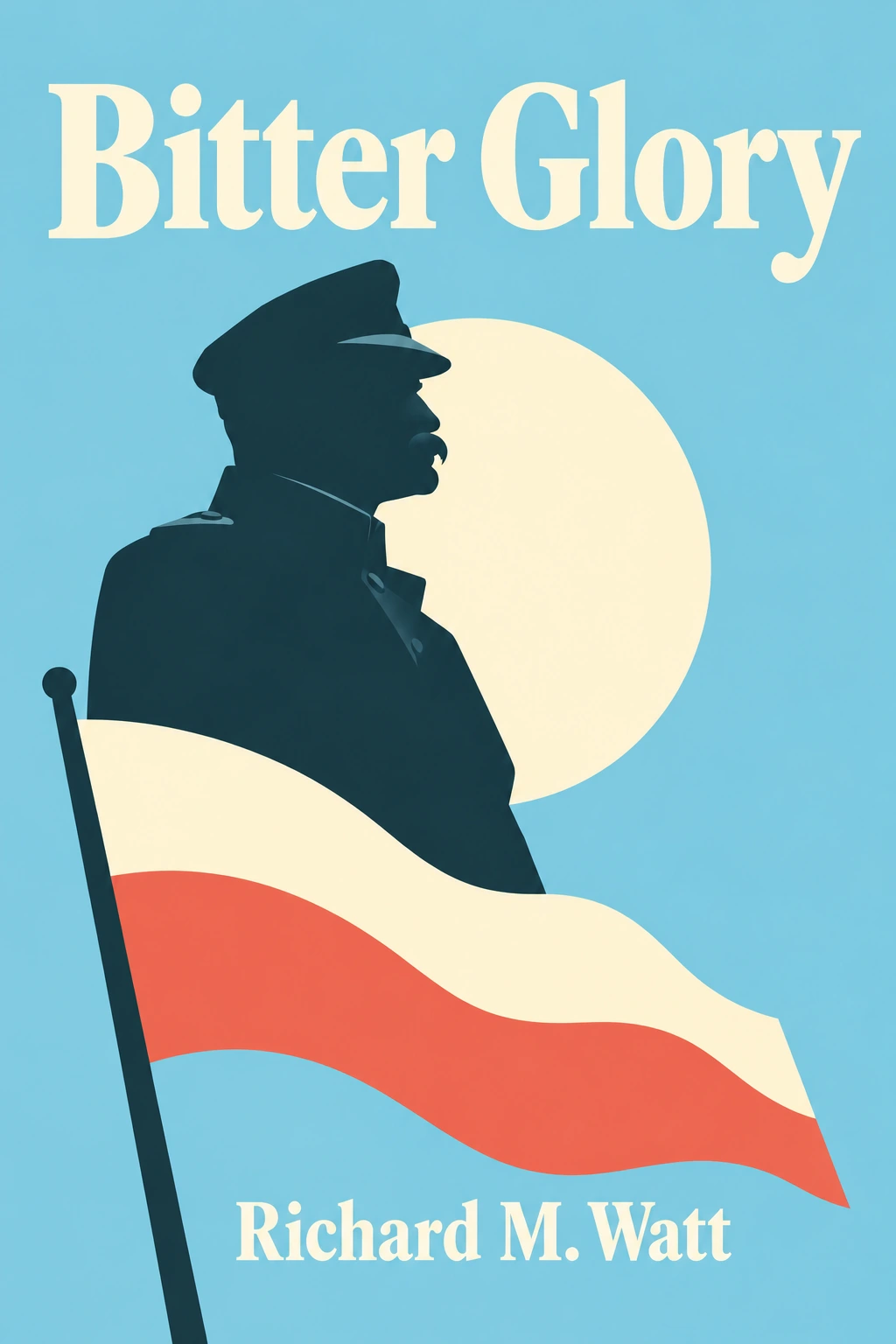
Bitter Glory: A Deep Dive into Poland's Interwar Struggle
Richard M. Watt's "Bitter Glory" chronicles the dramatic and often tragic story of Poland's struggle for independence and survival between 1918 and 1939. The narrative centers on Józef Piłsudski, a pivotal figure whose life mirrored the nation's tumultuous journey.
The Genesis of a Nation and its Unlikely Architect
Poland, erased from maps for over a century, was reborn from the ashes of World War I. Józef Piłsudski, a fervent revolutionary against czarist Russia, emerged as the driving force behind this rebirth. His early life was marked by activism, exile, and a deep-seated commitment to Polish liberation. Piłsudski understood that abstract ideals needed concrete action, leading paramilitary groups and engaging in sabotage. His vision extended beyond mere resistance; he recognized the crucial role of European power struggles in Poland's fate, influencing his pragmatic, even controversial, alliances. Watt portrays Piłsudski as a complex leader: charismatic and inspiring, yet also authoritarian and suspicious of parliamentary democracy. His early fight for freedom, forged in hardship, would later cast a long shadow over the independent nation.
Exploiting the Great War: A Calculated Gamble for Independence
World War I offered Poland an unprecedented opportunity amidst tragedy. Divided among Russia, Prussia, and Austria-Hungary, Polish leaders like Piłsudski saw a chance to play these powers against each other. Piłsudski initially allied with the Central Powers (Germany and Austria-Hungary), believing a weakened Russia was the primary obstacle to independence. He formed the Polish Legions to gain military experience and legitimacy. The collapse of the Russian Empire in 1917 shifted his strategy, focusing on securing Poland's borders against the remaining powers and the nascent Soviet Union. Polish diplomats in Allied capitals, like Roman Dmowski, also played crucial roles. President Woodrow Wilson's advocacy for Polish self-determination in his Fourteen Points provided vital international backing. However, independence was hard-won, marked by border disputes and the Polish-Soviet War (1919-1921). Piłsudski's command in the decisive Battle of Warsaw in 1920, the "Miracle on the Vistula," saved Poland and halted the westward spread of Bolshevism. Watt emphasizes that Poland's independence was not a gift but a hard-fought achievement through strategy, diplomacy, and military action.
The Fragile New State: Internal Strife and Looming Dangers
The newly independent Poland faced immense challenges. Integrating territories with different administrative, legal, and economic systems was a monumental task, creating deep regional fissures. Political instability plagued the parliamentary system, paralyzed by infighting among numerous parties. Piłsudski grew disillusioned with the perceived chaos and inefficiency, believing a stronger hand was needed. Economic hardship, including underdeveloped infrastructure, inflation, and unemployment, fueled social unrest. The state also faced external threats from the Soviet Union and strained relations with neighbors like Germany and Czechoslovakia. Watt documents how these pressures created an environment ripe for authoritarianism. The desire for order, understandable after decades of foreign rule, began to erode democratic foundations. Piłsudski's growing impatience led to his 1926 coup, ushering in an era of authoritarian rule. This period highlights the struggle to balance democratic aspirations with the need for decisive leadership in times of crisis.
The Coup of 1926 and the Drift Towards Authoritarianism
In 1926, Piłsudski seized power through a military coup, establishing the Sanacja regime ("sanitation" or "healing"). Driven by disillusionment with parliamentary paralysis and corruption, he believed strong leadership was essential for national stability. The coup, though relatively swift, resulted in casualties and fundamentally altered Poland's political trajectory. Under Sanacja, parliamentary democracy was undermined. Elections were often manipulated, and the parliament's powers were curtailed. Piłsudski's government increasingly relied on executive authority, restricting press freedom and imprisoning opponents. He justified these actions as necessary to "cleanse" politics and restore national unity, envisioning a strong, centralized state. This authoritarian drift, however, alienated segments of the population and stifled political debate. Piłsudski's legacy became ambivalent: a liberator who also curtailed freedoms, weakening democratic foundations just as war loomed.
The Shadow of Fascism and the Gathering Storm
As the 1930s progressed, Europe's geopolitical landscape grew ominous with the rise of aggressive regimes in Germany and Italy. Poland, situated between these powers and the Soviet Union, was in a perilous position. The Sanacja regime's authoritarian tendencies, while aiming for national strength, had also weakened its democratic resilience and alienated potential allies. Poland pursued a precarious policy of "equilibrium," signing non-aggression pacts with both Germany (1934) and the Soviet Union (1932). However, Hitler's expansionist ambitions and Stalin's consolidation of power rendered these pacts fragile. The book notes the rise of far-right nationalist groups within Poland, mirroring European trends toward authoritarianism, though Piłsudski's regime was not explicitly fascist. The Western powers' appeasement of Hitler, notably at Munich in 1938, signaled that Poland's security guarantees might be unreliable. As Hitler's demands escalated in 1939, Poland found itself trapped. Piłsudski's death in 1935 left a leadership vacuum. The nation, despite its military aspirations, was ill-prepared for the full might of Nazi Germany, especially after the Molotov-Ribbentrop Pact secretly divided Eastern Europe. The combination of external aggression and internal vulnerabilities sealed Poland's fate.