
Summary preview
Zeus: A Journey Through Myth and Time
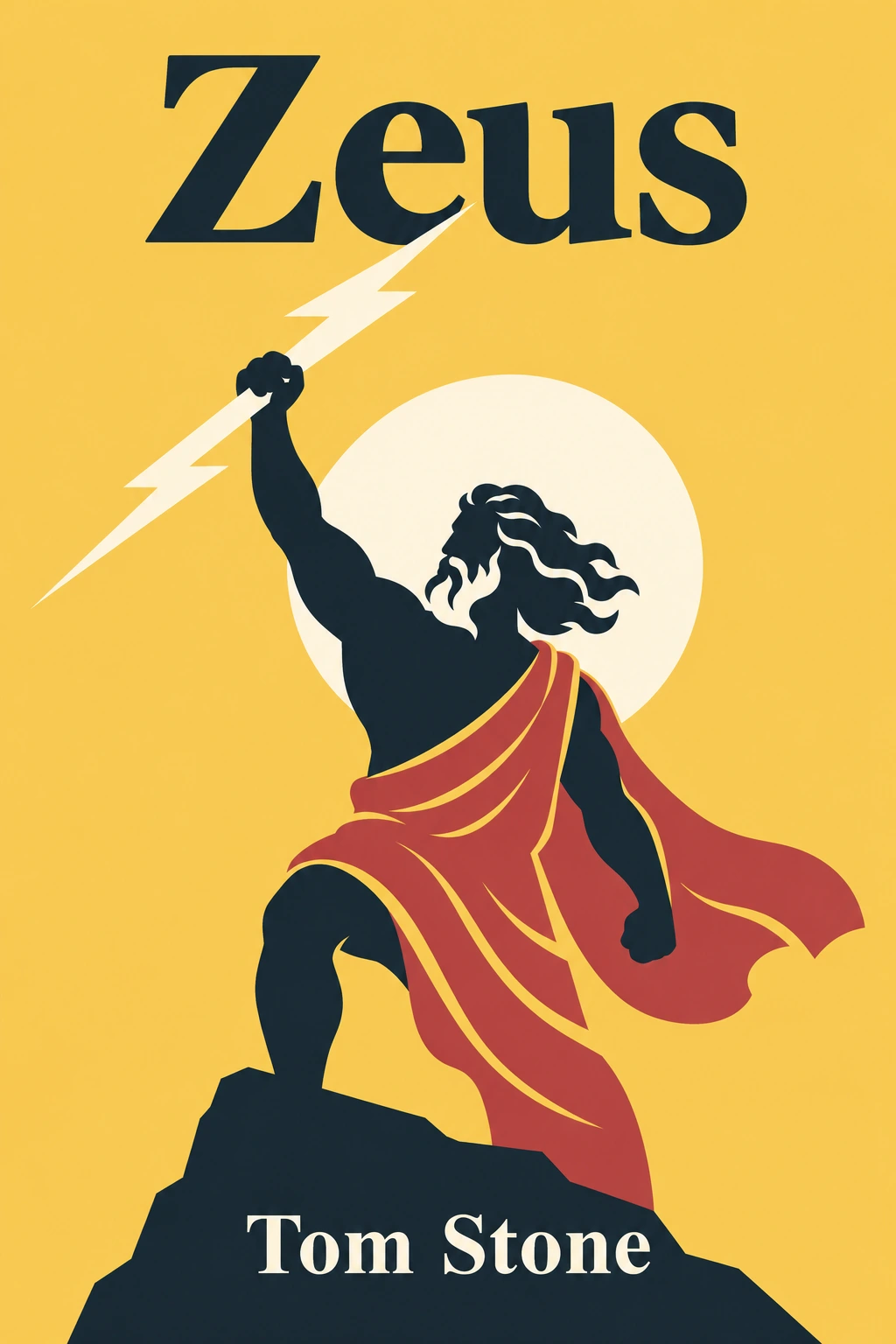
This book by Tom Stone offers an in-depth exploration of Zeus, the paramount deity of Greek mythology. The narrative spans millennia, tracing Zeus's existence from his origins in the Russian steppes to his reign on Mount Olympus and his eventual fading presence in Christian Constantinople. Stone's personal travels to these ancient locations lend a tangible and immersive quality to the story, which delves into themes of power, family drama, and the enduring impact of a single deity on the world.
Introduction: The Sky-Father's Grand Entrance
The book introduces the world of Greek mythology, centered around Zeus, the god of the sky. Tom Stone's "Zeus" is presented as an ambitious deep dive into the life and times of this deity, charting his journey from dangerous beginnings to his diminishing influence in a changing world.
The Genesis of a God: From Steppes to Olympus
The story begins in the primal landscape of the Russian steppes, the supposed origin point of Zeus and Indo-European mythology. This early phase depicts Zeus as an infant, hidden from his father Cronus, a titan who feared a prophecy that his children would overthrow him. Cronus’s act of swallowing his offspring was thwarted by Zeus's mother, Rhea. Zeus was smuggled to Crete, raised in secret, and protected by the Kouretes. This period of adversity and divine intervention shaped Zeus into a god forged in hardship, acutely aware of the fragility of power.
The Titanomachy: The War That Forged Olympus
Upon reaching manhood, Zeus embarked on a mission to free his siblings and claim his birthright, leading to the ten-year Titanomachy. This cosmic war saw Zeus, his brothers Poseidon and Hades, and his sisters Hera, Demeter, and Hestia, battle the elder generation of Titans. Wielding the thunderbolt, forged by the Cyclopes, Zeus proved to be the decisive force. The victory was a collective effort, with Zeus forming alliances with the Cyclopes and Hecatoncheires. Following the war, the spoils were divided: Poseidon received the sea, Hades the underworld, and Zeus claimed the sky and supreme rule from Mount Olympus, establishing the Olympian gods as the new pantheon.
Mount Olympus: The Seat of Power and Intrigue
Mount Olympus became the dazzling capital of the divine realm, where Zeus reigned. His court was a mix of divine majesty and dramatic intrigue. His marriage to his sister Hera was politically motivated, but their relationship was fraught with Hera's jealousy over Zeus's numerous affairs and illegitimate children. These myths highlight Zeus's charisma and desire, as well as Hera's vengeful nature. Zeus actively intervened in the mortal world, shaping heroes' destinies and dispensing justice, albeit often influenced by his personal biases. He was revered as the god of law, order, kingship, weather, and the sky.
Main Theses: The Pillars of Zeus's Legacy
Tom Stone's book is structured around several core arguments that explain Zeus's enduring significance: Thesis 1: The Evolution of Divinity and Power: Zeus's narrative reflects humanity's evolving understanding of divinity and power, from his origins as a primal sky god to his role as a cosmic king and his eventual decline in a monotheistic world. This charts the rise and fall of belief systems, showing how concepts of the divine are intertwined with cultural shifts. Thesis 2: The Intricate Web of Family, Power, and Conflict: Zeus's life exemplifies the complex and often brutal dynamics of family and power. His rise involved patricide, and his reign was continually challenged. The book emphasizes that power requires constant negotiation, defense, and management through alliances and force, offering a lens for understanding human political structures. Thesis 3: The Interplay Between Myth, Landscape, and Human Experience: Myths are presented not as abstract stories but as narratives deeply rooted in the physical world and human experience. Stone's travels to ancient sites demonstrate how engaging with the landscape provides a more profound connection to the myths and their origins. Thesis 4: The Shifting Role of Gods in a Changing World: The book traces Zeus's journey towards his decline as Christianity spread. This thesis explores how dominant belief systems change and how once-powerful figures can become relegated to folklore. Zeus's eventual "end" in Christian Constantinople signifies the transition from polytheism to monotheism.