
Summary preview
AstroOverview #206: A New Map of the Universe and Double Stars
Hey everyone! Welcome back to another exciting episode of 'AstroOverview.' Today, we've got a packed show with some absolutely mind-blowing topics that are going to change how we look at the cosmos. Seriously, buckle up!
Introduction: What's New in the Universe?
We're kicking things off with the biggest news: scientists have just unveiled the most detailed 3D map of the universe ever created. This isn't just a pretty picture; it's a revolutionary tool that could fundamentally alter our understanding of everything out there. We'll also be diving into the fascinating world of binary stars, exploring the surprising idea that having two suns might actually be better for forming planets. And of course, we can't forget updates from Mars, the Moon, and those intrepid deep-space explorers, the Voyagers. Let's get this cosmic party started!
Section 1: The Most Detailed Universe Map – What Are We Seeing?
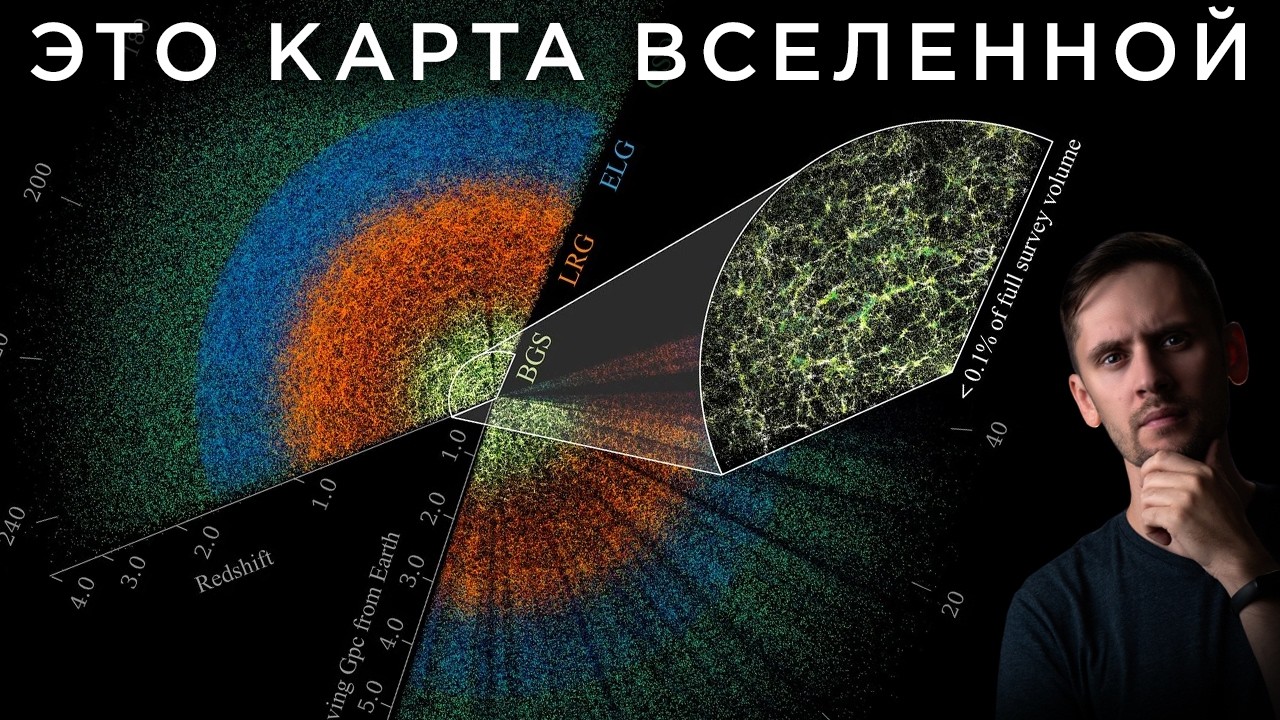
Imagine holding in your hands the most detailed map of the universe ever conceived. It’s almost too much to grasp! When we look at these incredible images of the universe's large-scale structure, it often looks like some kind of cosmic web, a vast network of filaments made up of galaxy clusters. We're talking about scales that span hundreds of millions, even billions, of light-years. It’s truly awe-inspiring, right? But it's super important to understand that these visualizations aren't like your typical photographs. We don't just point a telescope and get a ready-made picture. Instead, there are two main ways these cosmic maps are created: 1. Computer Simulations: These are our best attempts to recreate the universe's structure based on the physics we currently understand. They involve certain assumptions and simplifications, but they give us a fantastic idea of what things could look like. 2. Maps Built from Real Data: Every single dot on these maps represents a real, observed galaxy. By gathering and plotting tons of these observations, we can construct a map showing how galaxies are distributed. This isn't a simulation; it's based on actual observations, but it's still not a direct 'snapshot' in the way we usually think of photos. Our brand-new map falls into the second category. It's built from real observational data, and its defining feature is its absolutely astonishing level of detail. So, How Do We Even Build These Maps? To create a 3D map, we need to know the position of objects in three-dimensional space. The tricky part is that when we look out into the sky, we're essentially seeing a 2D projection. This is because these objects are incredibly far away. To get a sense of depth, we usually rely on methods like parallax, similar to how in old video games, the background moves differently from the foreground to create an illusion of depth. For stars, parallax works – we can measure their distances by observing them from different points in Earth's orbit. NASA's Gaia mission is a prime example of this, creating incredibly detailed star maps. However, parallax just doesn't cut it for galaxies. This is where redshift comes to the rescue. We know that if an object is moving away from us, the light it emits gets stretched, shifting towards the red end of the spectrum. The faster it moves away, the greater the redshift. On cosmological scales (billions of light-years), the speed at which a galaxy recedes is determined less by its individual motion and more by the expansion of spacetime itself. The farther away a galaxy is, the faster it's moving away from us, and the more its light is redshifted. By measuring this redshift, we can estimate a galaxy's recession velocity and, consequently, its distance. By adding this third dimension to our 2D view of the sky, we can build a 3D map of galaxy distribution. DESI – The Star of the Show This incredible new map is thanks to a remarkable instrument called DESI (Dark Energy Spectroscopic Instrument).
Section 2: Dark Energy and Rethinking Our Theories
One of the primary scientific goals of DESI is to study dark energy. This is one of the biggest mysteries in modern astrophysics. We know that the universe isn't just expanding; it's expanding at an accelerating rate, which is counterintuitive because gravity should be pulling things together and slowing down the expansion. We've given the cause of this acceleration the name 'dark energy.' We don't yet know what it is – it could be a property of spacetime itself, or perhaps something else entirely, like a new fundamental force. There are various hypotheses, but no definitive answers. By creating this incredibly detailed map of galaxy distribution over cosmic time, DESI allows us to meticulously study the history of the universe's expansion. We can observe how the distances between galaxies have changed over billions of years – 11 billion years ago, 7 billion years ago, and so on. By comparing these measurements with more recent data, we can get much closer to understanding the nature of dark energy. Why Is This So Important? Previous galaxy surveys, while groundbreaking for their time, simply lacked the necessary detail and scale to draw firm conclusions about dark energy's true nature. The sheer volume of data from the new DESI map, however, might finally provide the answers we've been searching for. Even the preliminary results from just one year of DESI observations have shown some intriguing discrepancies when compared to the standard cosmological model, which often treats dark energy as a constant, known as the cosmological constant. If these discrepancies hold up with the full dataset, it could mean we need to seriously rethink some of our most fundamental cosmological theories. What Does This Mean for the Future of the Universe? In the standard cosmological model, the universe is destined to expand forever, eventually leading to a 'heat death' where everything is cold and dispersed. However, the hints from DESI suggest that dark energy might not be constant; it could be changing over time, perhaps even weakening. If this is the case, the universe might eventually stop accelerating its expansion, slow down, and then, astonishingly, begin to contract again. Instead of a 'heat death,' we might be heading towards a 'Big Crunch.' Of course, scientists are being very cautious with these initial findings. The full analysis of five years of data is still ongoing, and the first major papers based on the complete dataset are expected next year. But it's already clear that these results have the potential to significantly reshape our understanding of the cosmos and its ultimate fate.
Section 3: Two Suns Better Than One? Planets Around Binary Stars
Now, let's switch gears from the grandest scales to something a bit more intimate, though still cosmic: what's better, one sun or two? A recent paper published in the journal of the Royal Astronomical Society suggests that in certain circumstances, binary star systems might actually be more advantageous for planet formation. Instantly, you might think of Tatooine from Star Wars, Luke Skywalker's home planet with its twin suns. While Tatooine is fictional, it raises real questions about the possibility of life and planet formation in systems with multiple stars. It’s a concept that has fascinated us for decades. The Two Flavors of Binary Systems Binary star systems generally come in two main configurations: 1. Widely Separated Stars: In these systems, the two stars are quite far apart. Each star can potentially host its own planetary system, provided the gravitational influence of the other star isn't too disruptive. 2. Close Binary Stars: Here, the stars are much closer together. Planets can orbit either one of the stars individually, or they can orbit both stars on a much wider, shared orbit – these are known as circumbinary planets. Tatooine is a classic example of a planet in a circumbinary orbit. The Challenges and Opportunities For a long time, the prevailing thought was that binary systems created significant gravitational instabilities. These instabilities were believed to disrupt the formation of planets, scatter protoplanetary disks, or even eject newly formed planets from the system altogether. This led to the hypothesis of a 'forbidden zone' around binary stars, an area where planet formation was thought to be nearly impossible. Estimates suggested this zone could extend out to many times the distance between the two stars. However, the discovery of the first few 'circumbinary' planets, like Kepler-16b (a gas giant), revealed that these planets were often found very close to their host stars. This led to theories that planets might form further out and then migrate inwards. Other similar planets (we've found around five thousand exoplanets now!) have been found orbiting at much wider distances. The New Research: Binary Stars as Planet Factories? Researchers behind this new study conducted extensive computer simulations to compare the efficiency of planet formation in single-star systems versus binary-star systems. Their focus was specifically on the formation of gas giant planets using a model called disk instability, where a massive, cool protoplanetary disk fragments under its own gravity to form planets directly. The simulations yielded a surprising outcome: while planets indeed struggle to form within the theorized 'forbidden zone,' outside of this zone, binary star systems could actually form planets more efficiently, faster, and in greater numbers than their single-star counterparts. So, Why Does This Happen? The more complex gravitational environment created by a binary star system introduces greater turbulence and instability
Section 4: Space News: Voyagers, Mars, and the Moon
Let's bring things back down to Earth a bit, or at least closer to our solar system, with some quick-fire space news updates. Voyager 1: Saying Goodbye to Instruments The farthest human-made object from Earth, Voyager 1, continues its incredible journey into interstellar space. However, as its power sources dwindle, its instruments are being shut down one by one. Recently, the instrument measuring low-energy charged particles was powered off. This leaves Voyager 1 with only two operational instruments, and its sibling, Voyager 2, with three. These probes are destined to drift through the galaxy as silent testaments to our civilization, long after we ourselves are gone. Mars: New Organic Molecules Discovered The Perseverance rover has made another exciting discovery on Mars: a diverse suite of organic molecules, including nitrogen-containing heterocyclic compounds. These are chemically similar to components found in RNA and DNA, the building blocks of life as we know it. Now, this isn't definitive proof of past life – organic molecules can also form through geological processes. However, each discovery like this increases the likelihood that Mars once harbored conditions suitable for life, and perhaps even life itself. The more organic finds we make, the closer we get to potentially answering that age-old question about life on the Red Planet. The Moon: A Rocket Stage on Collision Course Mark your calendars! In August of this year, the upper stage of a Falcon 9 rocket, which was launched into orbit back in 2015, is predicted to crash into the Moon. The impact is expected to occur on the near side of the Moon, near its limb, and there's a chance it might even be visible from Earth as a small flash. This isn't the first time a piece of space debris has hit the Moon, but each such event provides a unique opportunity for lunar observation and study.