
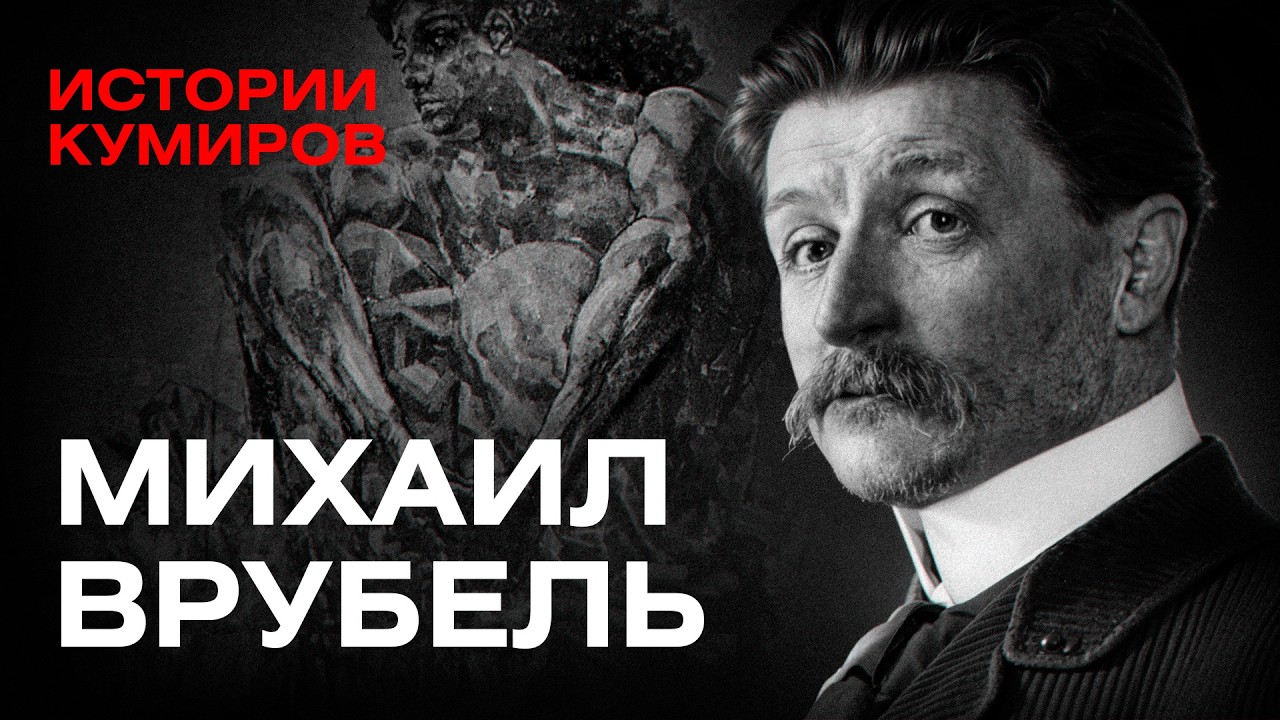
Summary preview
Mikhail Vrubel: The Genius, the Mystic, and the Demon
Hey there, art lovers and curious minds! Today, we're embarking on a real journey into the world of one of Russia's most enigmatic and talented artists – Mikhail Alexandrovich Vrubel. His name just screams mystery, deep meaning, and, of course, those infamous 'demons' that totally split society back in the day. You know, March 17th marked 170 years since his birth, which feels like the perfect excuse to dive deep and learn more about this absolute genius. Vrubel wasn't just another painter; he was a whole phenomenon in Russian art. He dabbled in everything: easel painting, decorative arts, church murals, and illustrations. He worked, as they say, 'like a madman,' but his art always stood out from his contemporaries. His canvases aren't just pictures; they're steeped in mystery, mysticism, and layered meanings that art historians are still trying to unravel. His 'demons,' in particular, caused a massive stir. They weren't just discussed; they sparked a full-blown scandal, dividing the public into two camps: some saw Vrubel as a genius, others as a madman trampling on moral foundations. So, who was this 'Vrubel's demon'? Was it the artist himself? A collective image? Or maybe it's that little something that resides within each of us? In this deep dive, we'll get to know Vrubel, his friends, the incredibly wealthy patrons who supported him, and, naturally, we'll plunge into the world of his demons. Ready to join this mystical journey? Let's get going!
The Beginning of the Path: 19th Century Russia and the Artist's Birth
Our story kicks off in the mid-19th century, a pretty turbulent time for the Russian Empire. The country was losing the Crimean War, and the elites were buzzing about the need for reforms. Amidst all this, debates raged about whether peasants should even be taught to read and write, and what the future held for Russia. It was during this era that Staff Captain Alexander Vrubel returned to Astrakhan. He came from a noble and well-off family, a catch of a groom who'd earned a medal in the Caucasus campaign. But his career wasn't his main focus – he dreamed of a family. Soon, he married his childhood friend, Anna Bassargina, the beautiful daughter of the Astrakhan governor. The wedding was modest, and Alexander soon returned to his service. The family was later transferred to Omsk, where Alexander and Anna welcomed their first child, a daughter named Anna. In the same year, the country was shaken by the death of Emperor Nicholas I. Alexander II ascended the throne, a ruler associated with major reforms. Meanwhile, Anna Bassargina was expecting their second child. On March 17, 1856, a boy was born and named Mikhail. Mikhail Vrubel. He was destined to become one of Russia's most recognizable, talented, and controversial artists. His 'demons' would ignite a storm of debate, with some calling him a genius, others sick, and still others the embodiment of evil. Vrubel's story is also intertwined with a scandal at the Nizhny Novgorod exhibition over his panel 'The Princess Dreamer,' which led him to publicly withdraw, only to return later thanks to the patron Savva Mamontov. Even Emperor Nicholas II would see his works. Plus, Vrubel would go on to paint the Kirillovskaya Church in Kyiv and create dozens of other masterpieces.
Childhood and First Steps in Art
Mikhail Vrubel was born a very weak and sickly child. His muscles were so weak that there was a real possibility he might never walk. His father, Alexander Mikhailovich, was distraught and pleaded with the doctors to do everything possible. The Vrubel home in Omsk felt like a infirmary, but the doctors managed to help little Misha. By the age of three, he was on his feet and walking. By this time, two more children had joined the family – Sasha and Katya. In 1859, life seemed to be settling down: a large family, father's career successes. But tragedy struck the family suddenly. Anna Grigoryevna fell ill with consumption, and her condition rapidly worsened. Doctors were powerless. His mother's death in 1859 was a devastating blow to young Mikhail. He stopped speaking and withdrew into himself. The only person he communicated with was his older sister Anna, who supported him throughout his life. After his wife's death, Alexander Vrubel was transferred back to Astrakhan, where his large family could receive help from relatives. It was there that young Mikhail discovered an old annual publication called 'Pictorial Review' featuring works of art. He spent hours studying the works of the best artists. Later, his attention was captured by his grandfather's library, where he first encountered the works of Shakespeare. In Shakespeare's books, he was captivated not so much by the texts as by the illustrations for 'Hamlet,' 'Romeo and Juliet,' and other plays. Once Mikhail learned to read, he would add his own drawings to the missing images in the books. Literature began to shape Vrubel's imagination and channel his energy into drawing. In 1860, the Vrubel family moved to Kharkiv. There, Mikhail began to draw constantly, capturing everything happening around him: his sister, his father, his brothers, guests. Visitors, seeing his drawings, spoke of the child's talent, but Mikhail himself was very reserved, earning him the nicknames 'Silent One' and 'Philosopher.' In 1863, Alexander Vrubel married Elizaveta Khristianovna Wessel, an intelligent and well-off woman from St. Petersburg. Her arrival brought a cultural atmosphere to the home: Elizaveta played the piano, read classics to the children, and oversaw their education. However, Mikhail, despite this, showed his independent streak, forming an unspoken alliance with his sister Anna and resisting many of his stepmother's suggestions. Nevertheless, Vrubel continued to hone his drawing skills and studied Latin and Greek. His teachers marveled at his progress and predicted a great future for him if he found his calling.
The St. Petersburg Period: Lyceum, Drawing School, and the Search for a Path
In 1863, the Vrubel family relocated to St. Petersburg. Mikhail enrolled in the Lyceum and asked his father to sign him up for a painting club. He was directed to the drawing school at the Society for the Encouragement of Artists. There, he learned the basics of composition, drawing cylinders, spheres, cones, and then plaster casts of heads. His drawings were distinguished by their accuracy and liveliness, as if they came alive on paper. Concurrently, Mikhail excelled at the Lyceum, receiving excellent grades in all subjects and studying the works of philosophers. A year later, the family moved again – to Saratov, where Alexander Vrubel was appointed commander of the provincial battalion. Mikhail protested; he loved the capital and the drawing school. His father hired a private tutor for him and took him along to Saratov so his son could continue his painting studies. To Mikhail's surprise, he grew to like Saratov. He continued his art studies and explored natural sciences. In 1865, a copy of Michelangelo's fresco 'The Last Judgment' was brought to the Saratov Catholic Church. Mikhail was so impressed that he tried to reproduce it from memory on paper, visiting the church repeatedly to study the details. Michelangelo became one of Vrubel's favorite artists. He admired the meticulous rendering of anatomy and body curves, which he strove to replicate in his own works. From 1867, the Vrubel family began moving again. They returned to St. Petersburg, where Mikhail attended the fifth gymnasium, and then moved to Odessa. Alexander became a garrison judge, and Mikhail enrolled in the Rechelevskaya Gymnasium, where he quickly became one of the top students, excelling in literature, Latin, history, and physics. However, in letters to his sister, he complained about the level of teaching in Odessa, noting that the educators saw no point in in-depth study of subjects. Vrubel believed that the number of class hours should be increased so that no one slacked off. He presented himself as a study fanatic, eager to grasp everything in the world. In Odessa, he also began attending a drawing school and painted a portrait of his beloved sister Anna. In 1874, Mikhail Vrubel graduated with honors from the Rechelevskaya Gymnasium. The question of further education arose. His father insisted on him pursuing a profession that could support him, while Mikhail himself dreamed of painting. To avoid upsetting his father, he successfully passed the entrance exams for the law faculty at St. Petersburg University and headed to the capital.
Law Faculty and a Secret Passion for Art
In St. Petersburg, Mikhail lodged with his uncle and began leading a vibrant life: he frequented entertainment venues, mingled with bohemians, fell for opera singers, and discussed art with composer Modest Mussorgsky. He was a true dandy and fashionista, spending money left and right. When funds ran out, he'd ask his sister or uncle, trying not to bother his father. His studies at the law faculty began to slide due to constant revelry. In his second year, Vrubel was held back a year due to absences and failed exams. This was a shock, and he didn't know how to tell his father. Eventually, Vrubel wrote to his father, fabricating a story that he had decided to repeat the course to consolidate his knowledge, supposedly having requested this from the dean. His father, touched by his son's 'sincerity,' was proud and sent money, which Mikhail promptly spent on entertainment. To avoid constantly asking for money, Vrubel became a tutor and governess in wealthy families, teaching children literature, history, languages, and drawing. He was valued so highly that he was provided with luxurious accommodation, meals, and even trips to Europe. Vrubel disliked his law studies; his soul yearned for visual art. Passing by the Academy of Arts, he suffered from the fact that he wasn't studying there. Nevertheless, he continued to draw: for himself and on commission, painting portraits of wealthy individuals and opera singers. In 1878, he created a pencil sketch 'Anna Karenina's Meeting with her Son,' where his signature style of rendering body curves and large, expressive eyes was already evident. By the end of his law studies, Mikhail began attending classes at the Academy of Arts' drawing department. In 1880, upon graduating from university, he immediately passed the entrance exams for the Academy and enrolled in his first year.
The Academy of Arts and Pavel Chistyakov's Workshop
Mikhail Vrubel found himself in the renowned workshop of Pavel Chistyakov, a legendary teacher at the Academy of Arts. Chistyakov, a talented artist himself, had developed a unique teaching system, focusing not only on painting but also on philosophy, literature, and history. He taught students to see deeper, understand the meaning of artworks, and develop discipline. Among his students were future stars like Vasnetsov, Roerich, Surikov, Polenov, Serov, and, of course, Vrubel. Vrubel was already 24 when he entered the Academy, but this didn't stop him from dedicating himself fully to his studies. The 16-year-old Valentin Serov also joined the same workshop. Imagine the scene: the workshop door opens, and there are Vrubel and Serov! From his first class, Mikhail displayed his knowledge of philosophy and literature, as well as unparalleled skill in working on sketches. Chistyakov praised him but often criticized, urging him to see more deeply and work more disciplinedly. Vrubel stayed after classes, studying anatomy using models of the human body, meticulously drawing muscles, joints, and tendons. This helped him better convey the vitality of human subjects in his paintings. He became a true 'Chistyakovite' but didn't forget his social life. Together with Serov and Vladimir Derviz, they formed a 'trio' that actively spent time in St. Petersburg establishments. Vrubel fell for Serov's cousin, Maria Simonovich, but never dared to confess his feelings. Interestingly, neither Vrubel nor Serov were poor. Both came from affluent families, which allowed them to lead such a lifestyle. In 1883, Vrubel painted an academic work, 'The Betrothal of Mary to Joseph,' for which he received a silver medal. The professors predicted a bright future for him.